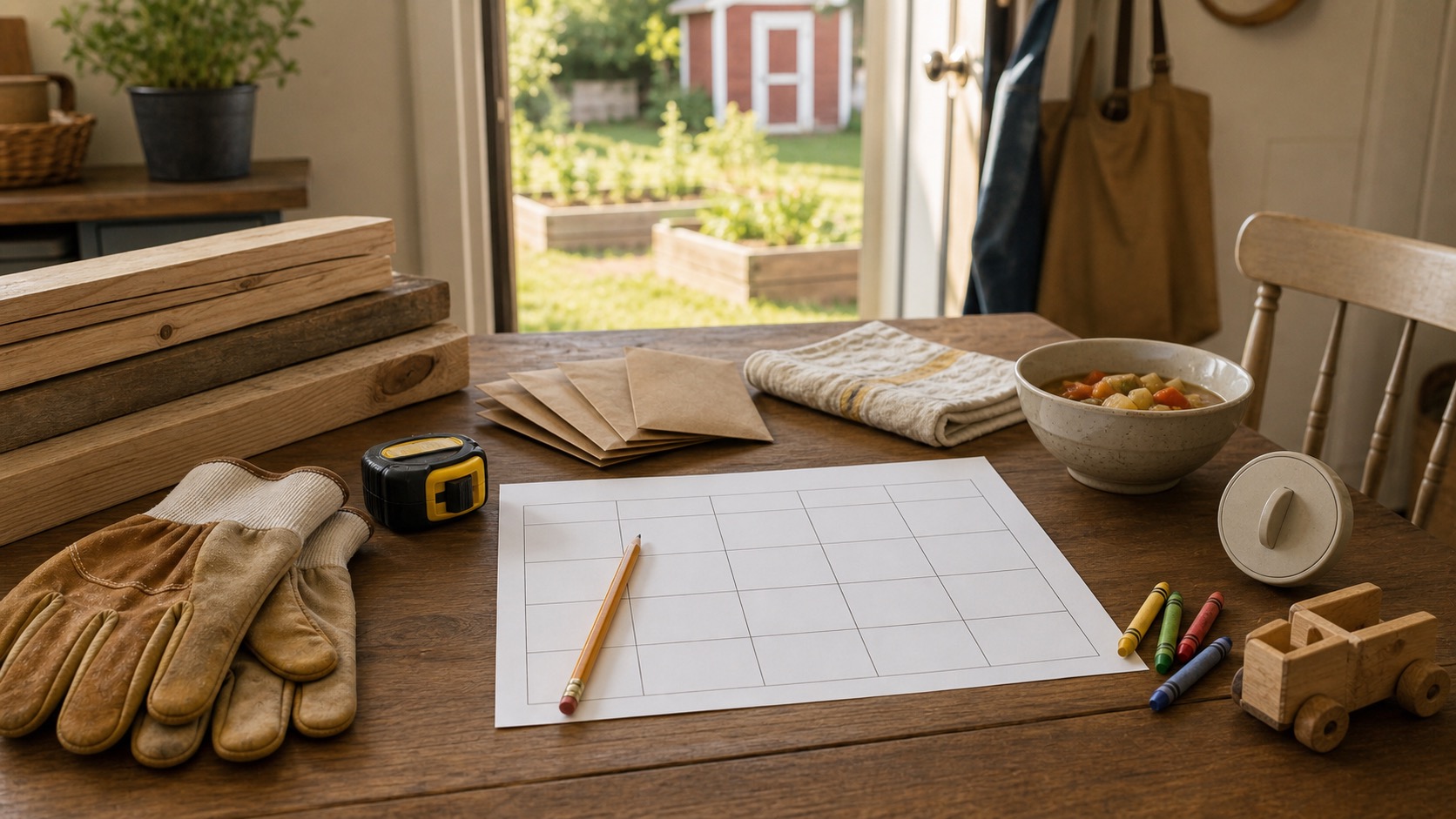
Homestead projects start taking over family life when they do not have edges. The fix is not to stop building useful things. The fix is to define the finish line, budget ceiling, work window, cleanup block, and family non-negotiables before the project gets a cart full of supplies and a whole weekend attached to it.
I understand the pull of a project that feels meaningful. A raised bed, coop repair, pantry shelf, compost area, fencing fix, or garden expansion can feel like the next honest step toward a steadier life. But a good project can still become a poor fit for the week if it quietly takes the meals, the rest, the conversation, and the margin it was supposed to protect.
The real decision is what the project is allowed to cost
The cost is not only money. A project also spends attention, weather windows, family patience, kitchen order, bedtime energy, vehicle time, garage space, and the mental load of remembering what still has to happen. Beginners often count the lumber and hardware but forget to count the household disruption.
That is why I like asking a harder question before a new project starts: what is this allowed to take over? If the honest answer is every evening until it is finished, that may be a warning sign. Some seasons really do require a push. But if every homestead improvement becomes a push, the family never gets to enjoy the steadier life the projects are meant to build.
A realistic beginner scenario
Picture a normal week. Work ran long, the laundry is behind, groceries still need a plan, one child has something on Saturday, the weather looks decent, and the garden project suddenly feels urgent. It would be easy to call the whole weekend a project weekend and assume everyone will adjust.
A better version is more honest: Saturday morning gets one bounded work block, lunch still happens at a normal time, cleanup starts before everyone is exhausted, and Sunday is not quietly mortgaged to finish what Saturday overpromised. That kind of boundary can feel slower, but it keeps the project from becoming the mood of the entire house.
The four boundaries I would set first
The first boundary is the finish line. Not the dream version. The smallest usable version. Build one bed, not the whole garden expansion. Repair the latch, not the whole shed. Clear one pantry shelf, not the entire storage system. A finish line needs to be plain enough that everyone can tell whether it happened.
The second boundary is the money ceiling. I do not like discovering the real project cost after the first supply run. Write the number down before buying materials, and include the boring things: screws, hinges, bins, soil, delivery, replacement parts, and the second trip you are pretending will not happen.
The third boundary is the stop time. A start time is easy. A stop time is what protects dinner, cleanup, bedtime, and the rest of the weekend. If the project cannot survive a stop time, it may need to be smaller.
The fourth boundary is the family no. Name what the project is not allowed to take this week. It might not take Sunday afternoon, a promised outing, the grocery plan, a quiet evening, or the only rest window in the week. That is not anti-homestead. That is the point of the homestead staying in service to the household.
Small tools that can help
A planner, timer, or notebook will not fix an overcommitted household by itself. But simple tools can make a boundary visible enough to keep. I would use what is already in the house first: scrap paper, a phone timer, a notes app, a cardboard box for project supplies. Buy only when the missing tool is clearly causing friction.
Recommendations
Project-boundary tools that can earn a place
Visible boundary
Large weekly planner pad
Useful when the whole family needs to see project blocks beside meals, errands, school, work, and rest.
Best for: Families who need project plans visible on the table or wall
Check current priceStop-time helper
Simple visual timer
Useful when cleanup time gets skipped or the project window keeps stretching by one more hour.
Best for: Households that need a clear stop signal instead of one more hour
Check current priceCheap control
Project notebook
Useful for measurements, costs, decisions, supply lists, and next-step notes when a project has to pause.
Best for: Small homestead builds, repair notes, and family project boundaries
Check current priceThose links are intentionally boring. A boundary tool should make the household calmer, not create a prettier way to overcommit. If a free piece of paper and a kitchen timer solve the problem, use those and keep the money for the project that actually needs it.
What can probably wait
Most beginners can delay parallel projects in several categories, weekend upgrades that need uninterrupted time, specialized tools for one unfinished build, and expanding scope because the supplies are already out. Delaying these does not mean giving up. It means refusing to spend future energy before the present system can hold.
Waiting is especially useful when the household has not yet recovered from the last improvement. If the shed is still full of unsorted supplies, the garden bed still needs cleanup, and the family is still adjusting to the new routine, the next project may need to sit on the list instead of entering the house.
How to include family without drafting everyone
Not every homestead project needs to become a family event. Sometimes the kindest version is one adult doing the work while everyone else keeps the house steady. Sometimes kids can help for twenty minutes with safe, clear tasks. Sometimes the family contribution is simply agreeing on the boundary before the project starts.
I am trying to be more careful with the language of togetherness here. There is a difference between inviting people into meaningful work and making them live around your unfinished idea. A project can serve the family without requiring every person to carry the same level of enthusiasm.
How to tell if the plan is working
A good project boundary leaves evidence. Tools get put away. The next step is written down. The family knows what changed. The project produces one usable improvement instead of three new piles. The house does not feel like it has to recover for days.
The clearest signal is how the house feels after the work stops. If the project made the week steadier, it probably belonged. If it left everyone short-tempered, behind, and surrounded by unfinished decisions, the scope was too large or the boundary was not real enough.
The useful next step
Pick one project already in your head and write the smallest usable version. Then write the money ceiling, the work window, the cleanup block, and the one family thing it is not allowed to take. If the project no longer fits after that, you did not fail. You learned the truth before the mess started.
That is what I want more of in our own home: progress that still feels like it belongs to the life we are building, not progress that wins the weekend and loses the room.
Best Next Step
Get the weekly planner before the week scatters again.
The weekly planner helps the advice become a real household pattern instead of another useful page you forget by Thursday.
Get the weekly plannerRecommended next reads
Read the next guide that supports this decision
These are the next pieces most likely to help the bigger picture make more sense without sending you in ten directions at once.
Systems
How to Build a Calmer Weekly Homestead Rhythm
A workable weekly rhythm matters more than bursts of motivation. This is how to structure a steadier, lower-drama home system.

Homesteading
Our First-Year Homestead Priorities: What We’re Doing Now and Why
A first year goes better when priorities are chosen, not inherited. These are the systems and projects we are focusing on now and the reasons behind them.
Homesteading
What I Wish I Knew Before Trying to Build a Simpler Life
A simpler life is not built by adding the right aesthetic. It is built by subtracting noise, choosing better systems, and learning what really matters.
Frequently asked questions
How do I keep homestead projects from taking over weekends?
Give each project a written finish line, a start time, a stop time, and a cleanup block before materials are purchased. One bounded project window is usually healthier than an open-ended Saturday.
What is a realistic homestead project boundary for families?
A realistic boundary protects meals, sleep, work, school, worship, rest, and basic household cleanup. If the project only works by stealing from those every week, the scope is too big for the season.
Should every homestead project be a family project?
No. Some jobs are better done by one adult, some can include kids in small safe pieces, and some need the family to be left out of the mess entirely. Agreement matters more than making every task togetherness.
What tools help keep projects contained?
A visible planner, a timer, one project notebook, and a basic tote or bin can help. They are useful only if they make the project easier to close, clean up, and return to later.
Recommendations
Useful tools and resources for this decision
These are included only where they reduce repeated friction, clarify a next step, or help you avoid buying the wrong thing first.
Visible boundary
Large weekly planner pad
A simple visible planner helps the family see project blocks, meals, school, rest, and cleanup time before the weekend gets overcommitted.
Best for: Families who need project plans visible on the table or wall
Check current priceStop-time helper
Simple visual timer
A timer is useful when project stop times keep getting vague, especially for cleanup blocks and kid-friendly helping windows.
Best for: Households that need a clear stop signal instead of one more hour
Check current priceCheap control
Project notebook
A plain notebook keeps measurements, costs, material lists, decisions, and unfinished next steps in one place instead of scattered across texts and receipts.
Best for: Small homestead builds, repair notes, and family project boundaries
Check current priceRecommended next reads
Read next if it helps the decision
Move into the next guide only if it clarifies the next practical step.
Systems
How to Build a Calmer Weekly Homestead Rhythm
A workable weekly rhythm matters more than bursts of motivation. This is how to structure a steadier, lower-drama home system.
Homesteading
Our First-Year Homestead Priorities: What We’re Doing Now and Why
A first year goes better when priorities are chosen, not inherited. These are the systems and projects we are focusing on now and the reasons behind them.
Homesteading
What I Wish I Knew Before Trying to Build a Simpler Life
A simpler life is not built by adding the right aesthetic. It is built by subtracting noise, choosing better systems, and learning what really matters.
Weekly rhythm support
Get the weekly reset planner that keeps the week from scattering.
A print-friendly weekly planner for resets, anchor tasks, and the few routines that make the house feel steadier.
Best for: Readers who need a calmer household rhythm before they need more projects.
- A weekly anchor planner
- A reset checklist
- A what-to-drop, delay, or delegate review
Low-noise notes on routines, resets, and steadier household systems.
After signup, the download will unlock right here so you can save or print it.
About the author
William Mock
Founder, writer, and beginner homesteader
William writes from the beginner side of rebuilding after a layoff: homestead plans, family systems, budgets, tools, and the decisions that make a home feel less fragile.
Read why this site existsRelated Guides
Keep building context
Systems
How to Build a Calmer Weekly Homestead Rhythm
A workable weekly rhythm matters more than bursts of motivation. This is how to structure a steadier, lower-drama home system.
Homesteading
What I Wish I Knew Before Trying to Build a Simpler Life
A simpler life is not built by adding the right aesthetic. It is built by subtracting noise, choosing better systems, and learning what really matters.
Homesteading
Our First-Year Homestead Priorities: What We’re Doing Now and Why
A first year goes better when priorities are chosen, not inherited. These are the systems and projects we are focusing on now and the reasons behind them.