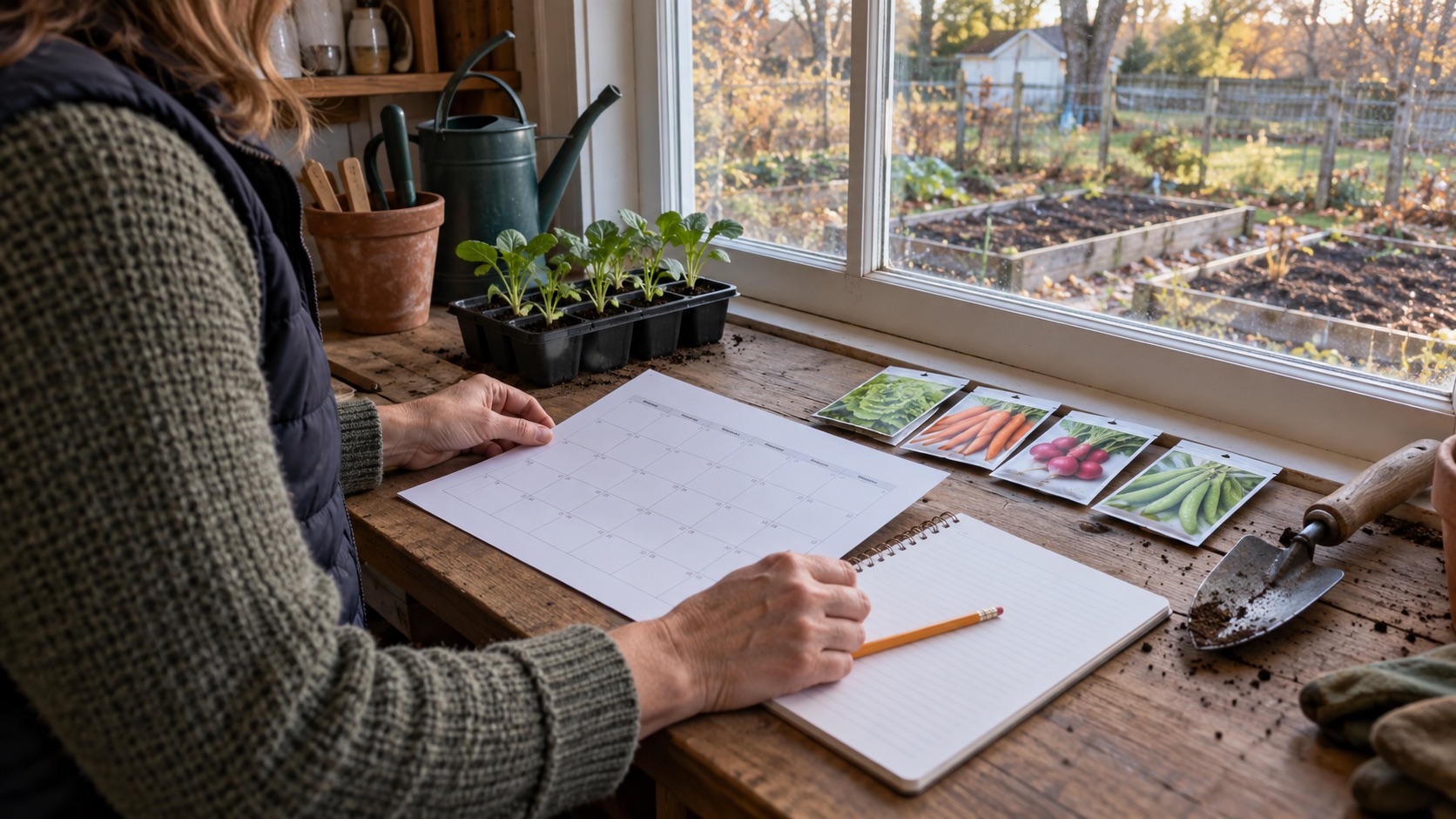
To make a beginner garden planting calendar, start with your local average last spring frost date, then count backward for indoor seed starting and forward for direct sowing and warm-season planting. Sort crops by frost tolerance, follow the timing on each seed packet, and leave room for weather to change the plan. A frost date is a useful anchor, not a promise from the sky.
The list that needed dates, not more ideas
I know the feeling of making a list where every line sounds worthwhile: learn composting, start seeds, price chickens, fix the pantry, plant more food. The list can look responsible while quietly becoming too much to carry. Garden planning has the same trap. A seed packet makes one more crop feel like a small decision, but each crop adds a date, a task, and later a harvest to use.
The helpful shift for me was asking what belongs this season, not what could be useful someday. A calendar gives that question a practical answer. It turns a hopeful stack of packets into a sequence, and it makes it easier to cross out a crop instead of pretending that every good idea needs a tray. That is progress too; the seed catalog will recover.
What a last-frost date can and cannot tell you
A local average last-frost date is a planning statistic, not a guarantee that frost cannot happen afterward. Purdue's Indiana Vegetable Planting Calendar describes its spring frost date as a probability: even near the listed date, a later freeze remains possible. The date also does not tell you whether soil is warm enough for a heat-loving crop or dry enough to work.
Use a county or state Extension calendar when possible. A national hardiness zone map is useful for perennial winter survival, but it is not a substitute for vegetable sowing dates. Local elevation, urban heat, slope, shade, and proximity to water can shift conditions even within one county.
Sort crops before you add dates
Make three plain categories. The exact crop group can vary by region and variety, so use Extension guidance and packet instructions for the plants you choose. This sorting step stops one frost date from being treated like a green light for every seed in the drawer.
Purdue's indoor seed-starting table gives examples of roughly 10 weeks before last frost for broccoli and cabbage, 7 weeks for tomatoes and peppers, and 4 weeks for cucumbers and squash. Those are useful examples for planning, not a universal recipe: varieties, indoor conditions, local climate, and the seed supplier's instructions matter.
Build your calendar in five steps
What to write down each week
A calendar becomes useful when it helps you make the next decision, not when it captures every possible gardening detail. Give each crop one short row with the variety, planned date range, whether you are sowing indoors or outside, and a blank line for what actually happened. Keep the seed packet or a photo of it nearby so the date is connected to the exact variety you bought.
Do not turn the notes into a verdict on whether you are good at gardening. They are field notes, not grades. If a crop missed its window, write down what happened and decide whether to try again, choose a faster variety, buy a transplant next year, or leave it off the list. That small review is how a calendar gets more local and more honest each season.
A sample backward count
Suppose your local Extension guide lists May 10 as a planning reference and your tomato packet says to start indoors seven weeks before transplanting. Count back about seven weeks to late March, then check the packet's growing conditions and local guidance. This is an example of the arithmetic, not a recommendation for every town or every tomato variety.
Keep the first calendar small and readable
Put only the crop, date range, task, and note on the first version. You do not need a color-coded spreadsheet with a dashboard that requires its own harvest. If a paper notebook helps you keep dates together, a basic garden planner is one option; a page from a regular notebook works just as well, and the affiliate link below is optional.
What to do next
A planting calendar works best after you choose a manageable garden and crops you will actually eat. Start with a realistic plan for your first homestead garden, then compare what to plant first in a beginner garden. If you are starting indoors, use the beginner seed-starting guide for light, labels, watering, and hardening-off basics.
The goal is not to predict every sunny afternoon. It is to know what belongs next, why it belongs then, and what you will change when real weather has other plans. A calendar that leaves space for reality is a much better gardening tool than a perfect schedule nobody can follow.
Frequently asked questions
How do I make a vegetable garden planting calendar?
Find your local average last spring frost date, sort crops by frost tolerance, read each seed packet for indoor-start and direct-sowing timing, then count backward or forward to put a few dates on a weekly calendar. Adjust for local Extension guidance, soil conditions, and the weather you actually get.
Should I use my last frost date to plan every vegetable?
No. Frost date is a useful reference, not a universal planting command. Cool-season crops may be planted before the average last frost, while warm-season crops often need warmer soil and nights after frost danger has passed. Check the crop and local guidance.
How many weeks before last frost should I start seeds indoors?
It depends on the crop and the seed source. Purdue Extension's indoor-starting guide lists about 10 weeks for broccoli and cabbage, 7 weeks for tomatoes and peppers, and 4 weeks for cucumbers and squash. Follow the variety's packet and local Extension advice rather than treating those examples as dates for every region.
Can I plant vegetables on the average last frost date?
Not every vegetable. The average date does not guarantee frost is over, and warm-season crops also need suitable soil and night temperatures. Use a local calendar, crop tolerance, forecast, and protection options before planting tender crops.
Do I need a garden planner to make a planting calendar?
No. A wall calendar, notebook, or simple spreadsheet is enough. A dedicated planner is optional; the useful part is recording the local dates, crop, variety, and what happened so next season's plan is based on your own garden notes.
How often should I update my garden planting calendar?
Review it when the forecast changes, when the soil is too wet or cold to work, and after each planting or harvest. Keep the original plan and note what changed instead of trying to make the calendar predict the weather perfectly.
Recommendations
Useful tools and resources for this decision
These are included only where they reduce repeated friction, clarify a next step, or help you avoid buying the wrong thing first.
Read the Purdue guide
Purdue Extension: Starting Seeds Indoors (HO-14-W)
A crop-by-crop table for counting backward from the last frost date, plus seedling care and transplant guidance. The suggested weeks are a starting reference; compare them with your packet and local conditions.
Best for: Checking indoor seed-starting windows for common vegetables
View resourceCheck the Indiana calendar
Purdue Extension: Indiana Vegetable Planting Calendar (HO-186-W)
An Indiana-specific reference for planting dates, frost probabilities, and crop timing. Gardeners elsewhere should use their own state or county Extension calendar instead.
Best for: Indiana gardeners who need regional dates and crop guidance
View resourceRead the Illinois guide
Illinois Extension: When Should I Start My Seeds?
Explains how seed packets connect indoor starting dates to a local average last frost date and why regional timing matters.
Best for: Understanding how to read seed-starting directions across a regional calendar
View resourceSee garden planner notebooks
Simple garden planner notebook
An optional place to record dates, varieties, and what actually happened. A regular notebook or a sheet of paper you already own works just as well.
Best for: Gardeners who prefer one reusable paper record for each season
Check current priceRecommended next reads
Read next if it helps the decision
Move into the next guide only if it clarifies the next practical step.

Gardening
What to Plant First in a Beginner Homestead Garden
A practical crop-selection guide for first gardens: what to plant first, what to skip for now, and how to choose crops that teach useful skills without overwhelming the week.

Gardening
Beginner Seed Starting Mistakes That Waste Time and Money
A practical guide to the seed-starting mistakes that waste money, kill momentum, and make a simple system feel harder than it is.
Gardening
How to Plan Your First Homestead Garden Without Doing Too Much
A successful first garden is smaller, clearer, and less romantic than many beginners expect. That is a good thing.
Garden gear support
Get the buy-first guide before the first garden collects too much gear.
Use the guide to decide which early garden purchases earn money now, which ones can be borrowed, and which ones can wait until the routine proves itself.
Best for: Beginners who keep seeing useful things online and need a disciplined way to decide what actually earns a place.
- A buy now, borrow, wait, or skip framework
- Starter category shortlists
- A three-question purchase test
Garden planning notes, restrained gear decisions, and the guide first.
After signup, the download will unlock right here so you can save or print it.
About the author
William Mock
Founder, writer, and beginner homesteader
William writes from the beginner side of rebuilding after a layoff: homestead plans, family systems, budgets, tools, and the decisions that make a home feel less fragile.
Read why this site existsRelated Guides
Keep building context
Gardening
How to Plan Your First Homestead Garden Without Doing Too Much
A successful first garden is smaller, clearer, and less romantic than many beginners expect. That is a good thing.
Gardening
What to Plant First in a Beginner Homestead Garden
A practical crop-selection guide for first gardens: what to plant first, what to skip for now, and how to choose crops that teach useful skills without overwhelming the week.
Gardening
Beginner Seed Starting Mistakes That Waste Time and Money
A practical guide to the seed-starting mistakes that waste money, kill momentum, and make a simple system feel harder than it is.