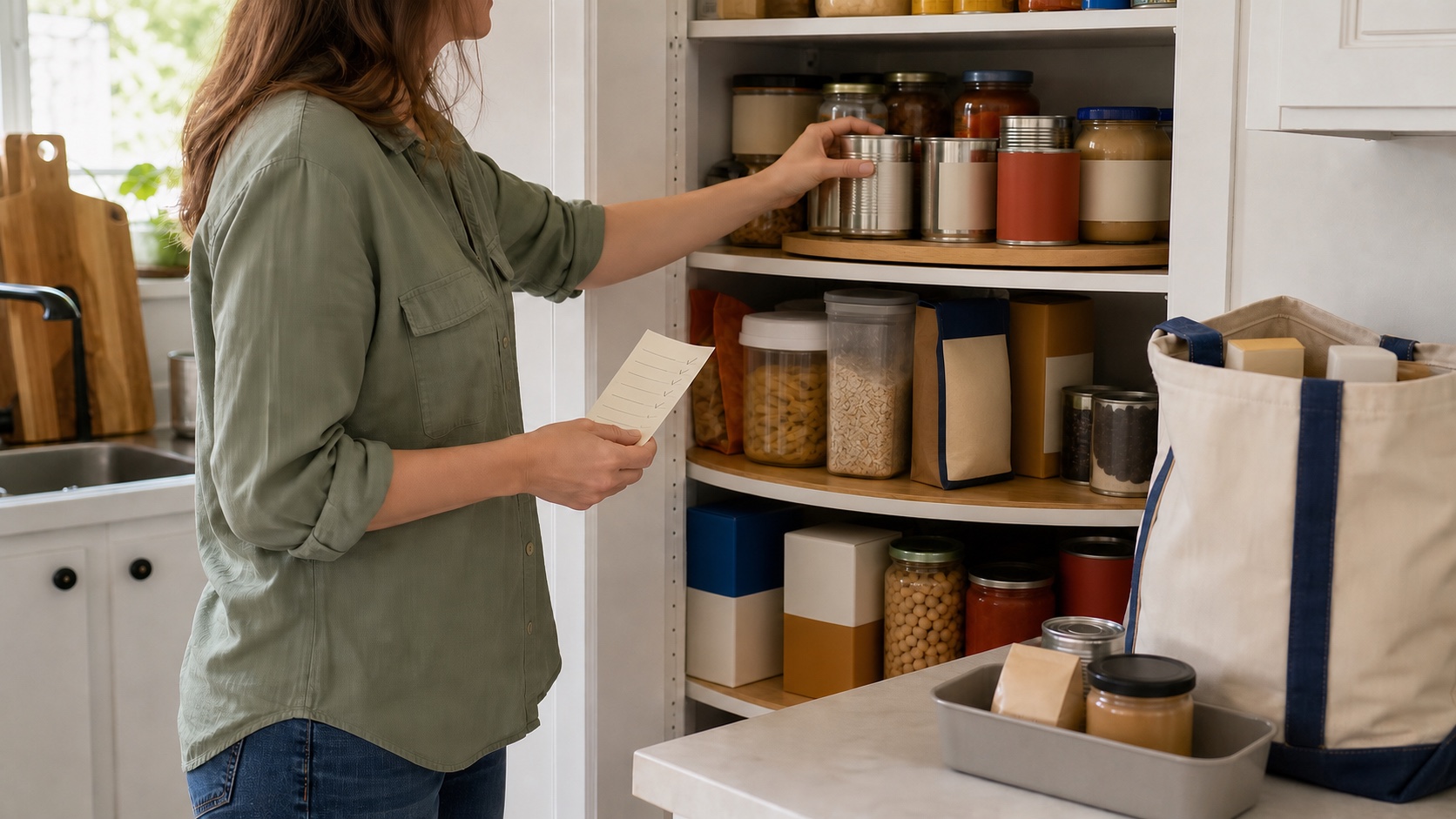
Build a rotating pantry around meals your household already eats, not around a universal emergency-food list. Start with five to seven repeat meals, keep one extra unit of their shelf-stable ingredients, place older food where it gets chosen first, and replace only what the household actually uses. Run that small loop for 30 days before buying deeper.
Start with the broader food-security plan
Build food security before the future property arrives
The cornerstone guide connects pantry rotation with freezer visibility, staple meals, a small growing experiment, and the purchases that can wait.
Build food security where you liveWhen a grocery trip started looking like runway
After the layoff, groceries stopped feeling like one ordinary household category. Every trip touched the bigger question of runway: how long the money had to carry us, what dinner would cost next week, and what kind of margin could make the house feel less exposed. It was easy to look at a sale and see security sitting on the shelf.
But food does not become security when the receipt prints. It becomes useful when somebody can find it, turn it into a meal, and replace it without pushing something older into a forgotten corner. A second jar of something we use can create breathing room. Twelve jars bought because the price looked urgent can tie up cash and hand the household a new rotation problem.
That changed the question for me. I did not need the pantry to look prepared. I needed it to prove that a normal grocery week could become a little steadier. The honest evidence was not shelf fullness. It was fewer duplicate purchases, more meals made from what we already had, and less food becoming an expensive surprise at the back of a cabinet.
A rotating pantry is a loop, not a stockpile
A working pantry has four actions: buy, store, use, and replace. If food enters but rarely leaves through ordinary meals, the loop is broken. Buying more will make the shelf deeper without making the household more resilient.
Start with five to seven pantry meals
Do not begin by listing foods. Begin by listing dinners. Choose five to seven meals the household already accepts and that rely meaningfully on shelf-stable ingredients. The meal can include fresh, refrigerated, frozen, or garden food too. The pantry's job is to carry the dependable base, not pretend every meal must come from a can.
For one family, the list might be pasta with tomato sauce and beans, soup with crackers, rice bowls, oatmeal and nut butter, tacos built from beans and shelf-stable components, or a simple curry. Those are examples, not a prescribed emergency diet. Allergies, medical needs, culture, age, cooking equipment, water, and household taste all change what belongs.
Use three pantry zones
The one-back rule is a starting limit, not a universal preparedness standard. A household may eventually need more depth because of distance from stores, seasonal income, local hazards, disability, dietary restrictions, or emergency guidance. The point is to earn that depth through use, storage capacity, budget, and a real plan instead of assuming more is always safer.
Rotate by use, condition, and guidance
First in, first out is a useful physical habit: older food moves forward and new food goes behind it. Utah State University Extension recommends storage shelves that make simple rotation possible so older food gets used first. But shelf position is not permission to ignore a damaged package, poor storage conditions, recalls, allergens, or preparation instructions.
USDA explains that most familiar package dates are about peak quality rather than an automatic safety cutoff; infant formula is the important federal exception. That does not make every old or damaged item acceptable. Inspect containers, follow the product's storage directions, check recalls when relevant, and discard swollen, leaking, badly rusted, or seriously damaged cans rather than tasting them to investigate.
Store food where the space can protect it
A deep shelf in a hot garage is not automatically better than a shallow cabinet in a steadier part of the home. Utah State Extension notes that storage temperature, light, pests, moisture, and time affect food quality. Use product-specific guidance, keep the area clean and dry, avoid spaces with obvious heat or pest problems, and do not block utilities, exits, ventilation, or safe access just to create capacity.
Do not decant the information away
Matching containers can make a pantry look finished while quietly separating food from the details the household needs. Original packages may carry allergens, preparation instructions, lot codes, recalls, quality dates, and storage directions. Keep food in its original package when that works. If a suitable food-safe container solves a real pest, moisture, or usability problem, move the necessary information with the food and do not combine new product with old residue without appropriate cleaning.
You do not need custom labels to start. A piece of removable tape, a plain marker, the original package, and one paper inventory can be enough. The system should help another person make dinner, not require them to understand your preferred container aesthetic.
A realistic 30-day pantry build
Imagine a household with one pantry cabinet, a normal grocery budget, and several foods already getting lost behind each other. The risky version empties the cabinet, buys organizers, and fills every gap in one weekend. The steadier version uses one month to learn the household before adding inventory.
What matters first, and what can wait
EPA recommends checking the refrigerator, freezer, and pantry before shopping, planning around what needs to be used, and buying realistic quantities. That is the weekly hinge of this system: look first, plan second, buy last. The order sounds small because it is. Small is what makes it repeatable.
A rotating pantry is not proof that nothing can disrupt the household. It is proof that a little more of the food already being purchased can stay visible, become a meal, and support a less frantic grocery week. If you are deciding whether pantry, garden, or chickens should be the first food system, use the beginner food-system comparison before adding another layer.
For us, that is the kind of fresh start worth building: not shelves that perform security, but ordinary systems that make the next hard week a little less dependent on memory, urgency, and a perfect trip to the store.
Budget support
Put a spending boundary around the pantry plan
Get the free First-Year Homestead Budget Worksheet to set a category limit, review what actually gets used, and keep food security from becoming another bulk-buying project.
Best for: Households trying to align purchases with this season's actual money, time, and attention.
- A spending-cap worksheet
- A buy, borrow, batch-later filter
- A quick review page for next-month decisions
Budget-first notes, honest tradeoffs, and the worksheet first.
After signup, the download will unlock right here so you can save or print it.
Recommended next reads
Build the next layer only after this one rotates
Use the food-security cornerstone for the broader plan, then compare pantry, garden, and chickens before choosing the next system.

Fresh Start
How to Start Building Food Security Before You Move
A practical guide to building food security before you move, buy land, or make a bigger lifestyle change.

Homesteading
The Best First Food System for Beginners: Garden, Chickens, or Pantry?
A practical comparison of three strong first food systems for beginners: pantry depth, a modest garden, or a small flock.
Budgeting
Does Homesteading Save Money? An Honest Beginner Breakdown
Homesteading can lower some household costs, but only when avoided purchases exceed setup costs, recurring inputs, and waste. Use this honest framework to find the systems that actually save.
Frequently asked questions
What is a rotating pantry?
A rotating pantry is a working supply of food that gets used in normal meals and replaced as it is consumed. Older or sooner-to-use items stay visible at the front, newer replacements go behind them, and the household buys only quantities it can reasonably use under the product's storage guidance. It is an active meal system, not a forgotten stockpile.
How much food should a beginner keep in a rotating pantry?
Begin with one extra unit of the shelf-stable ingredients used in five to seven repeat meals. Track what the household actually uses for 30 days before adding depth. Storage space, budget, dietary needs, local emergency guidance, packaging, and realistic rotation speed should determine the amount rather than a universal can count.
How does first in, first out work in a home pantry?
Place older items or those that should be used sooner at the front and put newer replacements behind them. Shop from the front when cooking and restock from the back after shopping. Check package condition and manufacturer storage instructions instead of assuming the oldest item is automatically usable.
Does a best-by date mean pantry food is unsafe after that date?
Not usually. USDA explains that, except for infant formula, common date labels generally describe quality rather than an automatic safety cutoff. Storage conditions, package integrity, product instructions, recalls, and signs of spoilage still matter. Never taste food to determine whether a swollen, leaking, badly rusted, or otherwise seriously damaged container is safe.
Do I need matching containers for an organized pantry?
No. Original packaging often preserves preparation instructions, allergen information, lot codes, and quality dates. Use a suitable food-safe container only when it solves a real storage problem, and transfer the product name, relevant instructions, date, and lot information when appropriate. Visibility and rotation matter more than matching shelves.
Recommendations
Useful tools and resources for this decision
These are included only where they reduce repeated friction, clarify a next step, or help you avoid buying the wrong thing first.
Free worksheet
First-Year Homestead Budget Worksheet
A free worksheet for setting a pantry spending boundary and separating useful meal depth from a bulk-buying project.
Best for: Beginners who need to protect grocery cash while adding a little pantry margin
Read the guideFederal source
USDA guidance for handling and storing foods at home
Federal guidance for storing foods received from stores, food pantries, food banks, or community kitchens.
Best for: Checking basic handling and storage practices before expanding pantry depth
View resourceFood-safety source
USDA food product dating guide
A plain-language explanation of best-if-used-by, sell-by, use-by, freeze-by, can codes, package condition, and the special rule for infant formula.
Best for: Readers trying to understand what package dates do and do not mean
View resourceExtension source
Utah State University Extension home food-storage guidance
Research-based guidance on storage environment, shelf design, pests, quality loss, shelf life, and using older food first.
Best for: Choosing a suitable storage area and understanding why conditions affect quality
View resourceFederal source
EPA guide to preventing wasted food at home
Current guidance for checking food on hand, planning meals, buying realistic quantities, storing ingredients, and using food before it is wasted.
Best for: Connecting pantry inventory to the weekly grocery and meal routine
View resourceRecommended next reads
Read next if it helps the decision
Move into the next guide only if it clarifies the next practical step.
Fresh Start
How to Start Building Food Security Before You Move
A practical guide to building food security before you move, buy land, or make a bigger lifestyle change.
Homesteading
The Best First Food System for Beginners: Garden, Chickens, or Pantry?
A practical comparison of three strong first food systems for beginners: pantry depth, a modest garden, or a small flock.
Budgeting
Does Homesteading Save Money? An Honest Beginner Breakdown
Homesteading can lower some household costs, but only when avoided purchases exceed setup costs, recurring inputs, and waste. Use this honest framework to find the systems that actually save.
Fresh start support
Get the first-step checklist that helps turn a reset into a real plan.
Use the checklist to pick one calmer next move, one budget frame, and one part of the bigger life rebuild to focus on first.
Best for: Beginners who need a first-season plan with limits, not more tabs or more gear.
- A first-season decision checklist
- A one-system starter plan
- A buy-now versus wait-later filter
Quiet notes for rebuilding, useful guides, and one real planning tool first.
After signup, the download will unlock right here so you can save or print it.
About the author
William Mock
Founder, writer, and beginner homesteader
William writes from the beginner side of rebuilding after a layoff: homestead plans, family systems, budgets, tools, and the decisions that make a home feel less fragile.
Read why this site existsRelated Guides
Keep building context
Fresh Start
How to Start Building Food Security Before You Move
A practical guide to building food security before you move, buy land, or make a bigger lifestyle change.
Homesteading
The Best First Food System for Beginners: Garden, Chickens, or Pantry?
A practical comparison of three strong first food systems for beginners: pantry depth, a modest garden, or a small flock.
Budgeting
Does Homesteading Save Money? An Honest Beginner Breakdown
Homesteading can lower some household costs, but only when avoided purchases exceed setup costs, recurring inputs, and waste. Use this honest framework to find the systems that actually save.