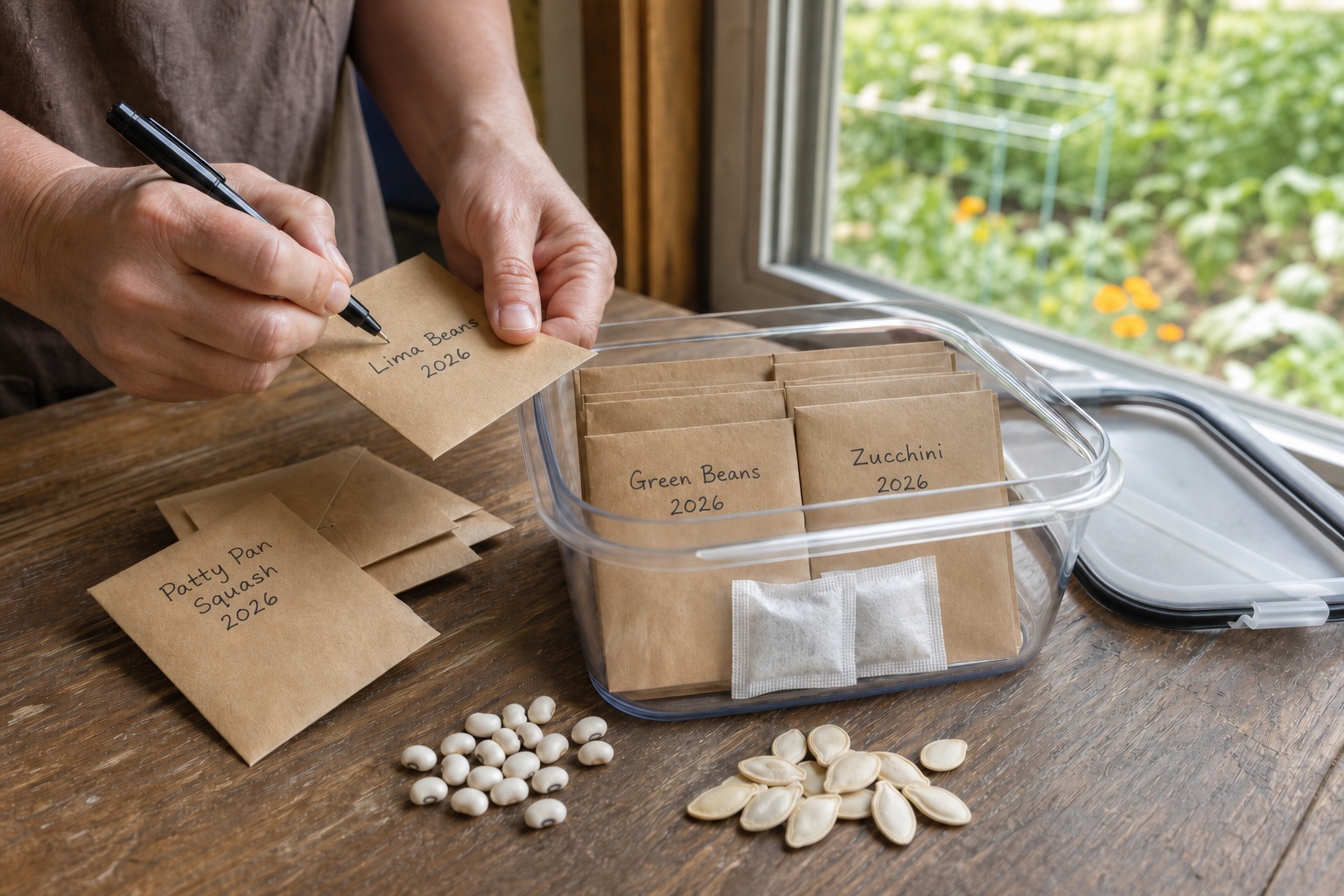
Leftover garden seeds do not need an elaborate organizer. They need to be dry, clearly labeled, protected from changing humidity, and kept somewhere cool enough that heat does not shorten their useful life. For most beginners, the practical setup is the original packets inside one airtight outer container, with the crop, variety, and year still easy to read.
The expensive part of too many seed packets came later
I have already written about the seed tray that changed my thinking. It was not a dramatic failure. It was simply too much: too many packets that felt reasonable in my hand, then too many labels, lights, watering decisions, and transplant dates once every packet became a living plant.
The quieter lesson showed up after planting. Half-used packets were tucked into a drawer, folded shut in different ways, and separated from the notes that explained what I had actually planted. Months later, those packets stopped looking like saved money. They looked like small paper questions. Was this the zucchini we liked? Was the packet from this year or the year before? Had it spent a humid week near the back door?
That is how the same variety can end up in the next seed order while usable seed is already in the house. The waste is not always dead seed. Sometimes it is seed I cannot find or trust when planting day arrives. A ten-minute storage routine fixed more of that problem than any expensive organizer could.
First decide what is worth saving
Do not seal every packet automatically. Airtight storage protects dry seed; it can also trap moisture around seed that was spilled, rained on, or handled with wet hands. Look at the packet and seed before it joins the rest of the collection.
Unknown seed is not dangerous merely because the label fell off, but it can be expensive in garden space. A mystery squash may cross paths with the variety you meant to grow, and a mystery tomato can take months to reveal that it was not worth a prime spot. Curiosity is fine. Just give it a separate label and a place where the experiment cannot displace a crop your family is counting on.
The simple leftover seed storage system
Iowa State University Extension recommends keeping seed dry and cool in a sealed jar or other airtight container. University of Minnesota Extension similarly recommends an airtight container in a cool location and notes that silica gel can help keep humidity low. The important point is not the brand or shape of the box. It is creating one stable, dry environment around all those small paper packets.
A kitchen drawer can work for a short season if the house stays cool and dry, but avoid locations that heat and cool repeatedly. Garages, sheds, sunny shelves, damp basements, laundry rooms, and the cabinet above a stove are convenient in the wrong way. Their temperature or humidity can swing while the seeds quietly lose vigor.
Should you refrigerate leftover seeds?
Refrigeration is useful, not mandatory. If you are carrying seed for several years or your house runs warm, a refrigerator can provide a steadier cool environment. The seeds must be dry, and the container must seal well enough to keep refrigerator moisture away from the packets.
Freezing is a long-term storage tool that depends on careful drying and truly moisture-proof packaging. It is more precision than most first gardens need for seed that will be planted next year. A cool closet plus an airtight container is a better starting point because it has fewer ways to go wrong.
How long common vegetable seeds can last
Seed life is a range, not an expiration date. The packet's age, its starting quality, and every hot or damp week in storage affect the result. Iowa State University Extension provides useful planning estimates for vegetable seed stored under good conditions, but it also emphasizes that a germination test is more informative than the calendar.
Those ranges can stop two opposite mistakes. You do not need to throw away every packet at the end of the season, and you should not give a ten-year-old onion packet the only row available for onions. Use the estimate to decide what deserves a test, then let actual germination make the planting decision.
Run a germination test before planting day
Test questionable seed about a month before you need it. Twenty seeds produce a more useful estimate than ten, and Iowa State notes that larger samples are better, but a ten-seed test is easy to calculate when a packet is small. Do not use so many that the test consumes the crop.
A low test does not mean every remaining seed is dead. It means the packet is less dependable. That distinction matters when timing is tight. A weak lettuce packet may be easy to sow heavily. A weak pepper packet started indoors may cost weeks before the empty cells tell you to begin again.
What is worth buying and what can wait
If you have three partly used packets, start with a jar or food container already in the kitchen. A specialized photo-case organizer, seed binder, temperature monitor, vacuum sealer, and dedicated refrigerator can all wait. None of them can replace dry seed and a readable label.
A small airtight container is worth buying when loose packets keep disappearing or your storage area is humid. Paper seed envelopes are useful when original packets tear or when you collect your own seed. Reusable desiccant makes sense when you know moisture is the recurring problem. Buy the item that fixes the actual failure, not the most impressive version of seed storage.
Before spring trays
Start fewer seeds with a clearer plan
Use the beginner seed-starting mistakes guide to choose what belongs indoors, match tray size to your light, and stop every interesting packet from becoming a February obligation.
Read the seed-starting guideThe goal is trustworthy seed, not perfect storage
Saving leftover seed is one of the easier ways to keep a garden budget honest. The win is not building a catalog-worthy shelf. It is opening one container next spring and knowing what is there, how old it is, and which packets deserve space in the garden.
Dry the packet, label the year, seal the container, and put one reminder on the winter planning calendar. That small routine turns a drawer full of questions back into next season's possibilities.
Recommended next reads
Plan the next planting season
These guides help turn saved seed into a realistic garden plan, from choosing what to start indoors to timing fall crops and keeping the whole first garden manageable.

Gardening
Beginner Seed Starting Mistakes That Waste Time and Money
A practical guide to the seed-starting mistakes that waste money, kill momentum, and make a simple system feel harder than it is.
Gardening
When to Start a Fall Garden for Beginners
A practical fall garden timing guide for beginners: how to work backward from first frost, choose cool-season crops, and plant a small second season without guessing.
Gardening
How to Plan Your First Homestead Garden Without Doing Too Much
A successful first garden is smaller, clearer, and less romantic than many beginners expect. That is a good thing.
Keep it practical
Build a first garden you can keep up with
Get the beginner homestead checklist and use it to choose a smaller first system, set a realistic budget boundary, and keep next season from becoming ten projects at once.
Practical notes from the work in progress. Low-noise and easy to leave.
Frequently asked questions
Can I use leftover garden seeds next year?
Yes. Most properly stored vegetable seeds remain useful beyond one season, although the expected life varies by crop. Keep the packets dry, sealed, labeled, and cool. Test older or questionable seeds before planting so a weak packet does not cost you part of the growing season.
Should garden seeds be stored in the refrigerator?
A refrigerator can be a good cool location when seeds are completely dry and sealed in an airtight, moisture-resistant container. Let the closed container warm to room temperature before opening it. That reduces the chance of humid room air condensing on cold seeds. A reliably cool, dry indoor closet is a simpler choice for one-season storage.
How long do vegetable seeds last?
Storage conditions and crop type both matter. Iowa State University Extension lists onion seed at about one year, corn and pepper at about two years, beans and carrots at about three years, tomatoes and squash at about four years, and cucumbers, lettuce, brassicas, and radishes at about five years under good storage conditions. Treat those ranges as planning estimates, not guarantees.
How do I test old seeds before planting?
Place a counted sample of seeds on a damp paper towel, roll or fold it, seal it in a labeled plastic bag, and keep it warm. Check it regularly for the normal germination period of that crop. Divide the number that sprouted by the number tested and multiply by 100. Eight sprouts from ten seeds is an 80 percent germination rate.
Can opened seed packets go into an airtight container?
Yes, as long as the seeds and packet are dry. Fold or clip the packet closed, record the crop, variety, and year, and place it inside a sealed outer container. Individual paper packets keep varieties organized; the outer container protects all of them from changing humidity and pests.
Should I freeze leftover garden seeds?
Freezing can support longer storage when seed moisture is carefully controlled and the container is truly moisture-proof, but most beginner gardens do not need it. For seed you expect to use next year, cool and dry storage is simpler. Freezing damp seed or repeatedly opening a cold container can create more risk than benefit.
Recommendations
Useful tools and resources for this decision
These are included only where they reduce repeated friction, clarify a next step, or help you avoid buying the wrong thing first.
Compare airtight containers
Small airtight food-storage container
A modest gasket-lid container gives opened packets one dry, pest-resistant home without turning seed storage into a large organizing project.
Best for: Gardeners with several partly used seed packets to carry into next season
Use a clean container you already own if its lid seals well. Buying a specialized seed organizer is optional.
Check current priceCompare desiccant packets
Reusable silica-gel packets
A small desiccant packet helps manage stray moisture inside a sealed container, especially in a humid house.
Best for: Humid storage areas or containers that hold seed for more than one season
Desiccant cannot rescue wet seed. Start with dry packets, follow the product directions, and keep packets away from children and pets.
Check current priceCompare seed envelopes
Plain paper seed envelopes
Small paper envelopes make loose or torn-packet seed easier to label by crop, variety, and year.
Best for: Saved seed, split packets, and labels that are starting to fall apart
The original packet is usually better because it keeps planting directions and variety details. Re-envelope only when it solves a real labeling problem.
Check current priceRead the Extension guide
Iowa State University Extension seed storage guide
A research-backed guide to cool, dry storage, paper-towel germination testing, and expected viability for common vegetable seeds.
Best for: Checking storage decisions and crop-by-crop seed-life estimates
View resourceReview seed-storage guidance
University of Minnesota Extension seed guidance
Practical guidance on storing packets in an airtight container, using desiccant, and keeping leftover seed cool.
Best for: Planning a simple household storage setup
View resourceRecommended next reads
Read next if it helps the decision
Move into the next guide only if it clarifies the next practical step.
Gardening
Beginner Seed Starting Mistakes That Waste Time and Money
A practical guide to the seed-starting mistakes that waste money, kill momentum, and make a simple system feel harder than it is.
Gardening
When to Start a Fall Garden for Beginners
A practical fall garden timing guide for beginners: how to work backward from first frost, choose cool-season crops, and plant a small second season without guessing.
Gardening
How to Plan Your First Homestead Garden Without Doing Too Much
A successful first garden is smaller, clearer, and less romantic than many beginners expect. That is a good thing.
Garden gear support
Get the buy-first guide before the first garden collects too much gear.
Use the guide to decide which early garden purchases earn money now, which ones can be borrowed, and which ones can wait until the routine proves itself.
Best for: Beginners who keep seeing useful things online and need a disciplined way to decide what actually earns a place.
- A buy now, borrow, wait, or skip framework
- Starter category shortlists
- A three-question purchase test
Garden planning notes, restrained gear decisions, and the guide first.
After signup, the download will unlock right here so you can save or print it.
About the author
William Mock
Founder, writer, and beginner homesteader
William writes from the beginner side of rebuilding after a layoff: homestead plans, family systems, budgets, tools, and the decisions that make a home feel less fragile.
Read why this site existsRelated Guides
Keep building context
Gardening
How to Plan Your First Homestead Garden Without Doing Too Much
A successful first garden is smaller, clearer, and less romantic than many beginners expect. That is a good thing.
Gardening
Beginner Seed Starting Mistakes That Waste Time and Money
A practical guide to the seed-starting mistakes that waste money, kill momentum, and make a simple system feel harder than it is.
Gardening
When to Start a Fall Garden for Beginners
A practical fall garden timing guide for beginners: how to work backward from first frost, choose cool-season crops, and plant a small second season without guessing.