
Choose a four-wheel garden cart when your repeated route is fairly open and you want a stable platform for bags, tools, firewood, harvest crates, or loose material. Choose a single-wheel wheelbarrow when the route is narrow, turns are tight, or you need to place and dump material from the front of the tray. A two-wheel wheelbarrow is the middle option: steadier than one wheel, but wider and less nimble. The right answer is determined by the route, ground, load, unloading point, storage, and person doing the work, not the largest capacity printed on a product page.
Practical homestead tools
Start with the job, not the equipment aisle
The tools hub connects buying guides, maintenance, storage, and the small pieces of equipment that earn their space through repeated work.
Explore homestead toolsThe load was only half the wheelbarrow job
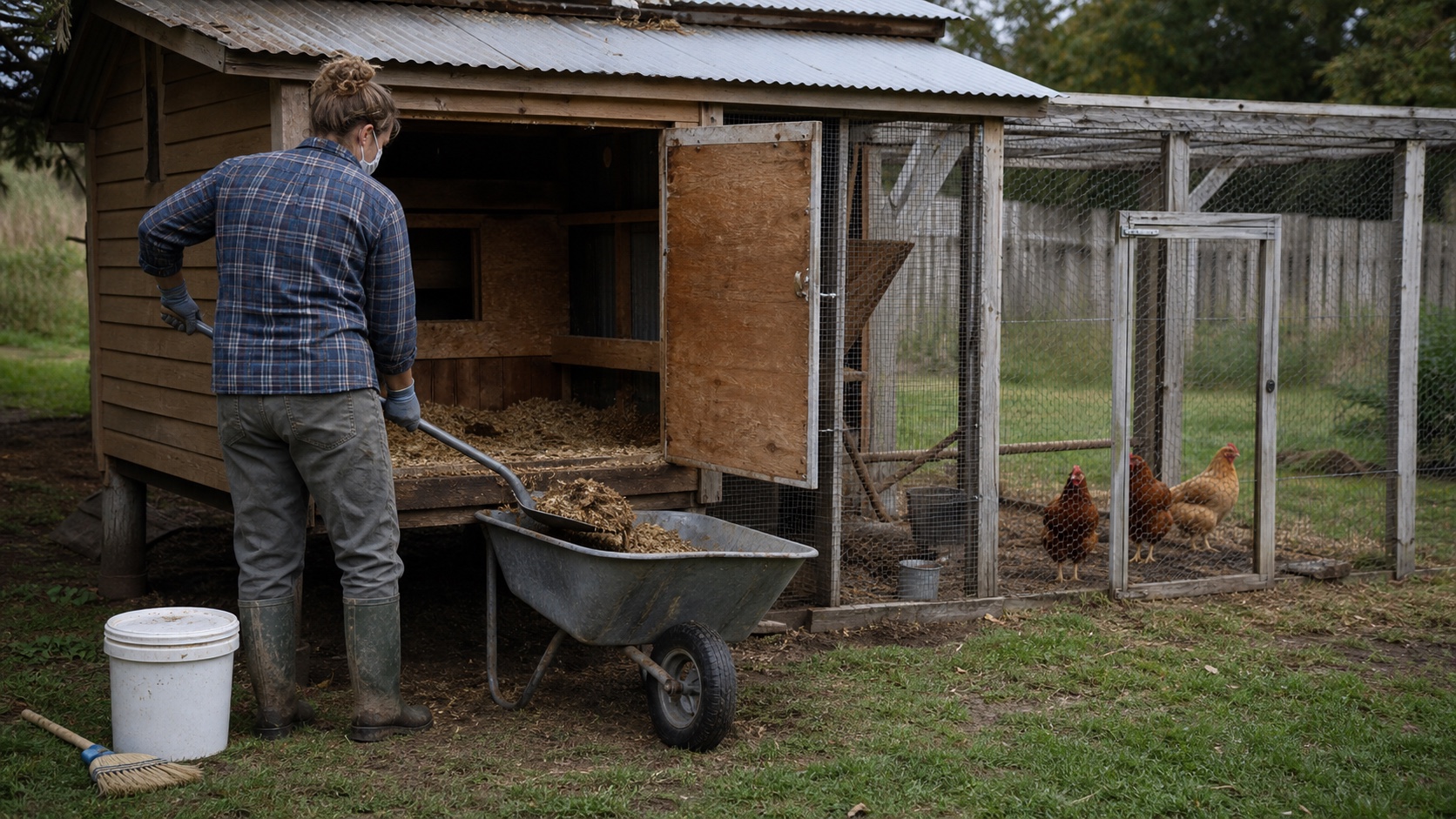
During a coop cleanout, I loaded the old bedding into a wheelbarrow and immediately saw the coop differently. Once the loose material was out, the floor, corners, roost area, damp spots, and places that had been hidden all became one honest map of how the setup was working. The wheelbarrow had done more than hold bedding. It had let me move one layer of the problem out of the way.
But that useful moment depended on something less interesting than the tray: I already needed a destination for the load and a route to get there. A full wheelbarrow parked in the wrong place is not finished work. It is a heavy decision blocking the next step. The gate has to open. The path has to carry the wheel. The pile, compost area, or disposal point has to be ready to receive what comes out.
That is why I no longer think the cart-versus-wheelbarrow question begins with capacity. It begins at the far end of the chore. Where will this material go, and what has to happen between here and there? The answer is usually visible on the property before it is visible in a product listing.
Compare the three common hauling designs
LSU AgCenter describes the traditional wheelbarrow as a hopper over one wheel with two handles, so the operator lifts part of the cargo while moving it. That single wheel can follow a narrow route and turn well, but the design is less steady. A cart puts the load on multiple wheels and changes the job from lifting and balancing toward pulling and steering. That design difference matters more than the label on the side.
Run the route test before shopping
Do the test with an empty cardboard box or scrap board cut to the published width if the fit is close. A cart that misses the gate by an inch is not almost right. A wheelbarrow that fits through but cannot turn at the compost area is not right either. The whole loop must work.
Match the tool to the load and the unloading method
A real wheelbarrow route
Plan the destination before the coop cleanout
The beginner coop-cleaning guide shows how bedding removal, inspection, dry cleaning, wet cleaning, drying, and fresh bedding fit one complete route.
Read the coop-cleaning guideCapacity is a limit, not a goal
A 600-pound equipment rating does not mean a person should pull 600 pounds across a yard. It does not describe the safe load for your slope, footing, turn, strength, weather, or material. It also may not equal the model's dumping limit. The exact 4GCG-NF manual says the rating assumes an evenly distributed load and gives a lower 300-pound maximum dumping load. Read the manual for the exact model because similarly named carts can have different limits.
Loose material becomes heavy quickly. If you do not know its weight, begin with a small load and learn how the tool starts, stops, turns, parks, and unloads on that route. Two manageable trips are better than one load that cannot be controlled at the worst point in the path.
Choose tires and bed material by maintenance
There is no maintenance-free choice. Flat-free tires still need axle, fastener, tread, and damage checks. Poly beds still need cleaning, shade when practical, and inspection. Steel still needs drying and rust attention. Buy the maintenance pattern you are likely to complete.
My researched compact cart pick
For a beginner with a wide gate, mostly open route, limited storage, and repeated mixed loads, my researched cart starting point is the Gorilla Carts 4GCG-NF. The manufacturer identifies it as a 4-cubic-foot poly dump cart with four 10-inch flat-free tires, and the model-specific manual lists a 600-pound overall maximum and a 300-pound dumping maximum for evenly distributed loads. The compact size is the reason it makes this list; I would not jump to a larger cart merely for a bigger capacity number.
I have not used this model long enough to present it as personal durability testing. This is a specifications-and-route recommendation. Verify the current model, dimensions, manual, assembly, warranty, replacement parts, and retailer terms before buying. Skip it if your narrowest opening or turn cannot accommodate it, your route is steep or badly uneven, you need single-wheel placement, or you do not have dry storage.
Researched compact option
Check the 4-cubic-foot flat-free dump cart
Use the exact model number to verify dimensions and limits. This retailer link may earn me a commission at no extra cost to you.
View the Gorilla cartBuy used, repair what you have, or wait
A used wheelbarrow can be one of the better early tool buys because the important parts are visible. Inspect the tray or tub for holes, deep cracks, severe rust, weak repairs, and damage around the mounting points. Check both handles, the frame, braces, axle, wheel, tire, fasteners, grips, and resting legs. Load it lightly and confirm that it tracks, parks, and dumps normally before paying.
Price the missing tire, handles, fasteners, or repair parts before calling a neglected tool a bargain. Our guide to homestead tools worth buying used first has the full inspection approach. For a four-wheel cart, also inspect the steering linkage, dump latch, bed pivots, axles, and parts availability for the exact model.
Spend after the inspection
Know what makes a used hauling tool worth buying
A low price only helps when the tray, frame, handles, wheel system, and replacement parts leave you with a dependable route-ready tool.
Inspect used homestead toolsWhat matters now and what can wait
If you are still learning what the property asks from you, buckets, a tarp, or smaller hand-carried loads may be enough for now. The land-and-equipment planning guide explains why repeating the work first can reveal whether the real need is carrying capacity, a better route, different storage, or no new machine at all.
Learn the work before scaling it
Do not let one hard chore choose your equipment plan
Track the task, frequency, route, labor, maintenance, and bottleneck before buying more land equipment than the household can support.
Read the equipment-planning guideThe decision in one sentence
Buy the smallest sound hauling tool that the regular user can control through the entire repeated route and unload at the real destination: usually a compact four-wheel cart for stable open-ground hauling, a single-wheel wheelbarrow for narrow and precise work, or a two-wheel wheelbarrow when added stability matters more than tight turning.
Frequently asked questions
Is a garden cart better than a wheelbarrow?
A four-wheel garden cart is usually better for stable pulling across relatively open ground and for mixed loads such as bags, tools, firewood, harvest crates, or loose material. A single-wheel wheelbarrow is usually better in narrow paths, tight turns, ramps, and jobs that need controlled placement from the front of the tray. Neither design is better everywhere; the shortest repeated route and unloading point should decide.
Is a one-wheel or two-wheel wheelbarrow better?
A one-wheel wheelbarrow turns more tightly and can follow a narrow track, but the user must balance the load. A two-wheel wheelbarrow offers more side-to-side stability while loading and moving, but its wider front end needs more path and turning room. Test the narrowest gate, sharpest turn, and intended dumping spot before choosing.
What size garden cart does a beginner homestead need?
Start with the smallest cart that carries the loads you can safely move and still fits the route and storage space. A compact 4-cubic-foot cart can suit many backyard chores without the width, weight, and storage demand of a large yard cart. Published weight capacity is an equipment limit, not a target load for the user or terrain.
Are flat-free or pneumatic tires better for a garden cart?
Flat-free tires remove air-pressure checks and puncture downtime, which helps around thorns, sheds, and occasional use. Pneumatic tires usually provide more cushioning over rough ground but require pressure and condition checks and can go flat. Choose by the route and maintenance you will actually do, not by the tire name alone.
Can I use a garden cart or wheelbarrow on a hill?
Slopes, side slopes, loose surfaces, wet ground, and heavy loads increase the chance of losing control or tipping. Follow the exact product manual, reduce the load well below the equipment limit, keep it stable and centered, wear suitable footwear, and avoid a route that exceeds your strength or the tool's instructions. A published capacity on level ground does not prove that a loaded tool is appropriate for a hill.
Recommendations
Useful tools and resources for this decision
These are included only where they reduce repeated friction, clarify a next step, or help you avoid buying the wrong thing first.
Best researched compact cart
Gorilla Carts 4GCG-NF 4-cubic-foot dump cart
A compact four-wheel poly dump cart with a steel frame, quick-release dumping mechanism, 10-inch flat-free tires, and a manufacturer-listed 600-pound maximum capacity.
Best for: Open backyard routes where stability, parked loading, flat-free tires, and a compact four-wheel footprint matter more than single-wheel turning
Check current priceManufacturer model source
Gorilla Carts 4GCG-NF product and parts page
The manufacturer's current page confirming the exact 4-cubic-foot flat-free model and providing model-specific parts support.
Best for: Checking the current model identity and replacement-parts path before buying
View resourceProduct manual
Gorilla Carts 4GCG-NF manual
The model-specific assembly, capacity, dumping, inspection, and operating instructions for the recommended cart.
Best for: Reading the limits and safety instructions before assembly or use
View resourceExtension comparison source
LSU AgCenter wheelbarrow and garden cart guide
Extension guidance explaining how wheelbarrow and cart designs change balance, maneuverability, loading, and practical use.
Best for: Understanding the design tradeoff before comparing brands or capacities
View resourceFree buying guide
What to Buy First guide
A free worksheet for ranking a cart, wheelbarrow, or repair by repeated work, route fit, storage, safety, time saved, and maintenance.
Best for: Deciding whether a hauling tool solves a current bottleneck or merely adds another object to store
Read the guideRecommended next reads
Read next if it helps the decision
Move into the next guide only if it clarifies the next practical step.

Tools
7 Homestead Tools Worth Buying Used First
The beginner-friendly tools that are usually smart to buy secondhand, plus the inspection rules that keep a bargain from becoming another repair project.
Chickens
How to Clean a Chicken Coop: A Beginner Schedule
Clean a chicken coop without turning every week into a full cleanout. Use condition-based checks, a safe step-by-step method, and a realistic beginner schedule.

Homesteading
What to Learn Before You Buy More Land Equipment
Before buying more land equipment, learn the land itself: drainage, slopes, access, repeat jobs, storage, maintenance, and whether ownership is actually the next wise step.
Buy-first support
Get the buy-first guide before you add another tool.
Use the buy-first guide to decide what earns money now, what can be borrowed, and what belongs on the wait list.
Best for: Beginners who keep seeing useful things online and need a disciplined way to decide what actually earns a place.
- A buy now, borrow, wait, or skip framework
- Starter category shortlists
- A three-question purchase test
Practical tool notes, restrained gear decisions, and one disciplined guide first.
After signup, the download will unlock right here so you can save or print it.
About the author
William Mock
Founder, writer, and beginner homesteader
William writes from the beginner side of rebuilding after a layoff: homestead plans, family systems, budgets, tools, and the decisions that make a home feel less fragile.
Read why this site existsRelated Guides
Keep building context
Tools
7 Homestead Tools Worth Buying Used First
The beginner-friendly tools that are usually smart to buy secondhand, plus the inspection rules that keep a bargain from becoming another repair project.
Chickens
How to Clean a Chicken Coop: A Beginner Schedule
Clean a chicken coop without turning every week into a full cleanout. Use condition-based checks, a safe step-by-step method, and a realistic beginner schedule.
Homesteading
What to Learn Before You Buy More Land Equipment
Before buying more land equipment, learn the land itself: drainage, slopes, access, repeat jobs, storage, maintenance, and whether ownership is actually the next wise step.