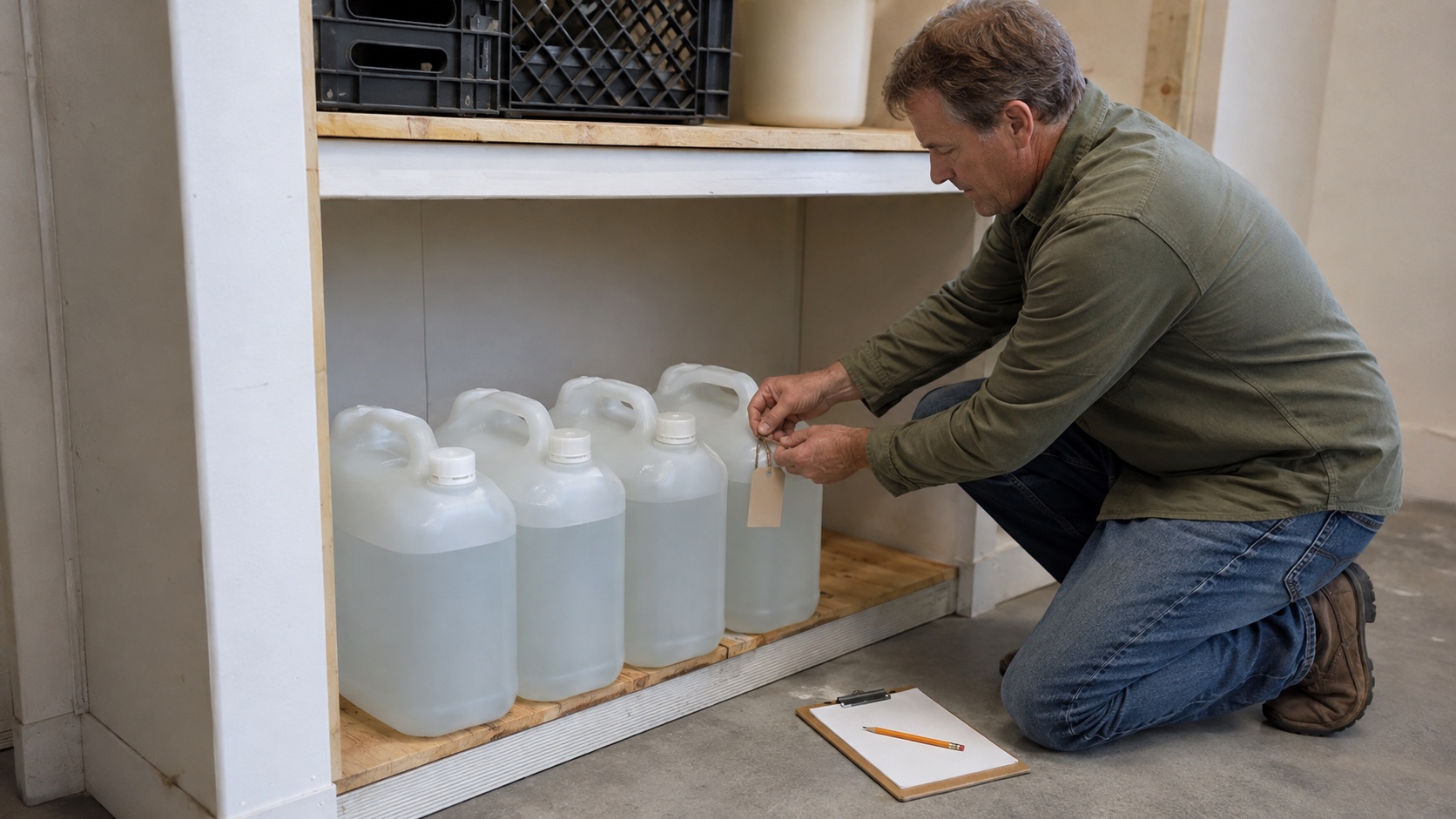
A beginner homestead should store at least one gallon of emergency water per person per day for three days. That is the CDC household baseline. If space, budget, and safe handling allow, work toward two weeks. Then calculate pets, livestock, medical needs, hot weather, and additional sanitation separately. For a family of four, the basic number is 12 gallons for three days or 56 gallons for two weeks before those additions.
The Pantry That Still Depended on the Faucet
After the layoff, I spent a lot of time thinking about what made a household feel less fragile. Food was the obvious place to look. A deeper pantry, a few meals we could make without a store run, and useful skills all felt like real progress. Then one quiet planning night, with the faucet working perfectly well, I mentally shut it off.
The first morning unraveled faster than I expected. Coffee needed water. Oatmeal needed water. Medicine, brushing teeth, washing hands, and cleaning up breakfast all reached for the same supply. Several of the sensible dry foods I had been proud to store were really stored ingredients plus an invisible promise that the faucet would keep working. Nothing dramatic had happened in the house. The exercise simply exposed a dependency I had not written down.
That changed the way I think about preparedness. I do not want shelves full of equipment that make us look ready. I want the first ordinary day to keep functioning. Water storage became less about preparing for a cinematic disaster and more about getting through coffee, meals, hygiene, pets, and the first round of decisions without panic. The most useful first move was not a giant tank. It was an honest number and a few containers we could rotate.
Protect the whole system
Build the backup plan around actual failure points.
The beginner homestead backup plan maps water, power, animal care, food, access, communication, and one next action before an outage or storm makes the decisions for you.
Build a homestead backup planCalculate the Human Baseline First
Use one gallon times the number of people times the number of days. The CDC says that water supports drinking, cooking, brushing teeth, and other uses during an emergency. Three days is the minimum planning target, not a guarantee that every disruption will end on day four. The same guidance says to try for a two-week supply when possible and notes that sick or pregnant people, pets, and hot climates may require more.
Write the human baseline before shopping. A four-person household that buys one 7-gallon jug has not finished a three-day supply, even though the container looks substantial. Twelve one-gallon bottles technically reach the number but may be wasteful or awkward for your storage. The right mix is the one that reaches the target, remains protected, and can be carried and poured by the people likely to use it.
Add Pets and Livestock as Separate Lines
Do not tuck every animal under the human one-gallon figure. For a dog or cat, measure normal daily drinking over several ordinary days, account for spills and cleanup, and ask your veterinarian how heat, illness, medications, age, or diet change the plan. Keep their water and a clean way to serve it near the household supply.
Livestock is a different scale. Species, body size, feed moisture, production stage, temperature, and water-delivery method can change demand sharply. Use your veterinarian or local Cooperative Extension guidance for each group, observe normal use in both mild and hot weather, and identify how water will physically reach each animal if the pump or normal line is down. A written number with no delivery method is not yet a livestock water plan.
Choose Water Containers for Use, Not Appearance
The CDC identifies unopened commercial bottled water as the safest and most reliable emergency source. For water you fill at home, use containers made for food or drinking-water storage. Look for a tight closure, durable construction, and an opening that limits contact during dispensing. Never repurpose a jug that held fuel, pesticide, cleaner, or another toxic substance, even if it has been washed.
Capacity is not automatically convenience. A gallon of water is heavy, so a large container may be difficult for a child, older adult, injured person, or anyone with limited strength to move. Before buying several matching jugs, decide who will lift them, where they will sit, how they will be poured, and whether the shelf or floor location can safely support the total load. Follow the container maker's instructions about filled stacking; the Aqua-Tainer manufacturer, for example, says that model stacks only when empty.
Store and Rotate Water on Purpose
For home-filled containers, follow the CDC's current cleaning and sanitizing instructions rather than improvising a method from memory. Label each container as drinking water and add the storage date. Replace home-filled water every six months. Keep it in a cool place, ideally in the CDC's stated 50 to 70 degree Fahrenheit range, away from direct sunlight and separated from gasoline, pesticides, and other toxic substances. Follow commercial bottlers' storage directions and dates for sealed water.
During use, keep hands out of the water and use only a clean utensil or dispenser. A spigot is useful only if it stays clean, protected, and compatible with the exact container. Store replacement caps or parts only after confirming the manufacturer's model and opening size; a bag of almost-right fittings is not resilience.
Do Not Confuse a Water Source With Safe Water
A homestead may have a well, creek, pond, rain barrel, cistern, livestock tank, water heater, or filter. Those are useful parts of a broader plan, but they are not automatically safe drinking water in every emergency. Floodwater, fuel, chemicals, salt, heavy metals, microorganisms, equipment damage, or a failed power supply can change what is usable. Boiling and ordinary disinfection do not remove every chemical contaminant.
Follow the exact local advisory for the event. A boil-water notice and a do-not-drink notice are not interchangeable. If you rely on a private well and it has flooded or may be contaminated, EPA says not to drink or wash with that water and to stay away from a flooded pump because of electrical-shock risk. Contact local or state health officials and use a qualified well or pump professional for inspection, cleaning, disinfection, and testing. The stored supply gives you room to follow those steps without rushing.
What to Buy First and What Can Wait
Buy enough suitable capacity to close the first three-day household gap. That might be sealed commercial water, a few manageable home-filled containers, or a practical combination. The two Aqua-Tainer sizes included with this guide are here because the manufacturer publishes current food-contact claims, dimensions, closures, and replacement-part information. I am not presenting them as personally field-tested or as the only good choice. Verify the exact model and seller, inspect it on arrival, and follow both CDC and manufacturer directions.
A manageable first container
Check the current 4-gallon Aqua-Tainer listing.
Confirm the exact size, model, seller, manufacturer specifications, and your ability to carry it when full. This retailer link may earn me a commission at no extra cost to you.
View the 4-gallon containerThe Best First Target Is the One You Can Maintain
Do the household math tonight. Find the difference between what you have and the three-day minimum. Close that gap with known-safe water in sizes your household can use. Then schedule the first rotation and write separate animal, medical, heat, and sanitation lines. That is a stronger system than buying an impressive amount of gear and assuming the details will sort themselves out during an outage.
Water storage is not dramatic work, and that is why I like it. It turns resilience into a dated container, a reachable shelf, and one less question waiting for a hard day. The faucet may be working while you build the plan. That is exactly when the plan is easiest to build well.
Keep food practical too
Build a pantry that gets used before it gets forgotten.
The rotating-pantry guide connects ordinary meals, visible inventory, and a simple first-in-first-out habit so stored food remains part of normal life.
Build a rotating pantryFrequently asked questions
How much emergency water should I store per person?
The CDC says to store at least one gallon per person per day for three days and, if possible, work toward a two-week supply. That baseline covers drinking, cooking, brushing teeth, and other uses. Hot weather, illness, pregnancy, pets, and other household needs can increase the amount required.
How much water does a family of four need for an emergency?
Using the CDC baseline, a family of four needs at least 12 gallons for three days: four people times three days times one gallon. A two-week household baseline is 56 gallons. Add separately for pets, livestock, unusual heat, medical needs, and any extra sanitation demand.
Does the one-gallon rule include pets and livestock?
No. Treat one gallon per person per day as the human household baseline. Measure what each pet normally drinks and ask a veterinarian about special needs. For livestock, use species-, age-, production-, feed-, and weather-specific guidance from your veterinarian or local Extension office, then plan a separate way to store and deliver that volume.
What containers are safe for emergency drinking water?
Unopened commercial bottled water is the CDC's safest and most reliable option. For water filled at home, use containers intended for food or drinking-water storage with tight closures, durable construction, and openings that can be protected from hands and contamination. Never reuse a container that held toxic chemicals.
How often should stored emergency water be replaced?
The CDC says home-filled water should be labeled with the storage date and replaced every six months. For commercially bottled water, follow the manufacturer's date and storage directions. Inspect every container for leaks, damage, a loose cap, or contamination before relying on it.
Can I count rainwater, a pond, a cistern, or a flooded well as stored drinking water?
Do not count an untreated source as ready-to-drink emergency water. Conditions and contaminants vary, and boiling or disinfection does not remove every chemical contaminant. Keep a separate supply of known-safe water and follow current instructions from local authorities, the CDC, or EPA for the specific emergency and source.
Recommendations
Useful tools and resources for this decision
These are included only where they reduce repeated friction, clarify a next step, or help you avoid buying the wrong thing first.
Vetted rigid container
Reliance Aqua-Tainer 7-gallon water container
A rigid 7-gallon container with a molded handle, screw-on vent cap, and reversible hideaway spigot. The manufacturer lists the current Aqua-Tainer as food safe, FDA compliant, PFAS-free, and BPA-free.
Best for: Households that have a cool indoor storage location and can safely lift, move, and pour from a full 7-gallon container
Check current priceMore manageable size
Reliance Aqua-Tainer 4-gallon water container
The smaller version of the same current container, with a molded handle, vent cap, and hideaway spigot. Its lower filled weight may make rotation and pouring more manageable.
Best for: Older adults, smaller households, upper storage locations, or anyone who finds a full 7-gallon container awkward to move safely
Check current priceManufacturer source
Reliance Aqua-Tainer product specifications
The manufacturer's current specifications for the 4- and 7-gallon models, including dimensions, materials claims, closures, spigot, and the warning that Aqua-Tainers stack only when empty.
Best for: Checking the exact model, dimensions, handling features, and storage limits before buying
View resourcePrimary safety source
CDC emergency water supply guide
Current federal guidance for how much water to store, suitable containers, home-filled water sanitation, labeling, six-month replacement, storage conditions, and clean dispensing.
Best for: Building and maintaining the drinking-water portion of a household emergency plan
View resourcePrivate-well safety source
EPA private-well emergency guidance
Current guidance for protecting private well water, testing, and responding after flooding or another event that may have contaminated the well.
Best for: Households that depend on a private well or need a flood-specific water plan
View resourceRecommended next reads
Read next if it helps the decision
Move into the next guide only if it clarifies the next practical step.
Systems
How to Build a Homestead Backup Plan Before You Need It
A practical one-page homestead backup plan for sick days, travel delays, power or water problems, and any day the usual caretaker cannot carry the routine.
Fresh Start
How to Build a Rotating Pantry Without Wasting Food
Build a small rotating pantry around meals your household already eats, then use a simple three-zone system to keep older food visible, useful, and out of the trash.
Budgeting
How Much Emergency Fund Does a Beginner Homestead Need?
A practical way to build a beginner homestead emergency fund without confusing household savings, recurring costs, repairs, and future projects.
Weekly rhythm support
Get the weekly reset planner that keeps the week from scattering.
A print-friendly weekly planner for resets, anchor tasks, and the few routines that make the house feel steadier.
Best for: Readers who need a calmer household rhythm before they need more projects.
- A weekly anchor planner
- A reset checklist
- A what-to-drop, delay, or delegate review
Low-noise notes on routines, resets, and steadier household systems.
After signup, the download will unlock right here so you can save or print it.
About the author
William Mock
Founder, writer, and beginner homesteader
William writes from the beginner side of rebuilding after a layoff: homestead plans, family systems, budgets, tools, and the decisions that make a home feel less fragile.
Read why this site existsRelated Guides
Keep building context
Systems
How to Build a Homestead Backup Plan Before You Need It
A practical one-page homestead backup plan for sick days, travel delays, power or water problems, and any day the usual caretaker cannot carry the routine.
Fresh Start
How to Build a Rotating Pantry Without Wasting Food
Build a small rotating pantry around meals your household already eats, then use a simple three-zone system to keep older food visible, useful, and out of the trash.
Budgeting
How Much Emergency Fund Does a Beginner Homestead Need?
A practical way to build a beginner homestead emergency fund without confusing household savings, recurring costs, repairs, and future projects.