
A homestead backup plan should let a trusted person protect the essentials when the usual caretaker cannot: people first, then water, animals, containment, food safety, and the few property systems where waiting would create harm. Keep the quick instructions to one page, name the backup before you need them, and test the plan during an ordinary day instead of discovering its gaps during a fever, delayed trip, outage, or family emergency.
The day availability stopped looking permanent
One of the stranger lessons after the layoff was realizing how much of an ordinary week had been built around a calendar I thought I understood. Work disappeared from the schedule, but the rest of the household did not become simple. Meals still had to happen. Bills and paperwork became more urgent. Family life kept moving while interviews, benefits calls, and decisions started landing wherever they could fit.
That season changed the way I look at availability. A person can be responsible and still become unavailable with almost no warning. The reason might be a job interview across town, a sick child, a flat tire, a delayed flight, an injury, or simply a day when the person who normally remembers everything cannot carry one more decision. The important work does not need a heroic substitute. It needs a smaller path that another person can actually follow.
That is the part of backup planning I find useful: it exposes knowledge we have mistaken for a system. If only one person knows which latch sticks, how far the hose reaches, which bird needs watching, where the shutoff is, or what can wait until tomorrow, the routine is more fragile than it looks. Writing it down is not pessimism. It is a way to stop one hard day from becoming five new problems.
Start with two different plans
A normal backup-care sheet and an emergency action plan are related, but they are not interchangeable. The first answers, 'What must happen today if I cannot do it?' The second answers larger questions about fire, evacuation, storms, blocked access, power and water loss, hazardous materials, medical emergencies, livestock movement, and who has authority to make decisions.
Penn State Extension specifically frames livestock emergency planning around the possibility that the primary caretaker is unavailable for consultation. University of Minnesota Extension emphasizes communication, maps, access routes, inventories, contacts, supplies, sheltering, and evacuation. Those are useful standards, but a beginner does not need to turn tonight's chore sheet into a pretend commercial-farm manual. Build the ordinary handoff first, then expand the plan to match the real risks and systems on the property.
Write the first-visit page
The first page should work for somebody arriving tired, in bad weather, or without you standing beside them. Use plain nouns and observable actions. 'Check the chickens' is not an instruction. 'Count six hens, refill the marked waterer from the frost-free spigot, confirm the feed door and two run latches are closed, and call if any bird is separated or cannot stand' gives the helper a finish line and a stop rule.
Keep sensitive account numbers, alarm details, medical information, and records somewhere appropriately secure rather than taping everything to a public-facing door. The care sheet needs enough access information to work, but convenience should not turn it into a map of every vulnerable part of the property.
Build the plan in care layers
Not every unfinished task has the same consequence. A good backup plan protects the work in layers so the helper is not trying to recreate your whole day. People and immediate safety come before property. Water and animal welfare come before garden appearance. Containment and weather exposure come before egg collection. A loose project board can wait. A loose livestock gate cannot.
Write a short power-and-water branch
A power outage can affect more than lights. Depending on the property, it can change well-water access, pumps, heat, ventilation, electric fencing, brooders, freezers, refrigeration, communications, and medical devices. Do not hand a helper a generator they have never operated and call that a plan. Fuel, exhaust, transfer equipment, electrical connections, placement, and maintenance carry serious risks and need manufacturer instructions and qualified guidance.
Ready.gov recommends a household communication plan, local alerts, a supply kit, and planning for the hazards that affect your area. CDC advises keeping refrigerator and freezer doors closed during an outage and gives current time-and-temperature guidance for food, water, and refrigerated medications. Link those official instructions in the plan rather than rewriting a fragile rule from memory. Local health departments, utilities, emergency management, veterinarians, and equipment professionals may need to guide the property-specific response.
Choose backups by job, not goodwill
The person who can collect mail and water porch herbs may not be the person who should handle livestock, operate equipment, give medication, or respond to a failed well. That is not a judgment about willingness. It is a reason to split the plan. One neighbor may handle a short chicken round. A family member may make household decisions. A veterinarian, electrician, plumber, utility, or emergency service handles work outside the helper's training.
Test it on a boring day
Do not wait for travel or trouble to discover that the gate key looks like three others, the feed scoop has no quantity, the hose valve turns the opposite direction, the flashlight batteries are dead, or the contact list still has an old number. Ask the backup person to complete one care round while you stay available but quiet. Every question they ask is a place where the system still lives in your head.
This is where a simple clipboard or binder earns its place. The tool is not the system. The successful handoff is the system. Use the beginner homestead binder guide for the deeper records, maps, seasonal notes, and contacts, but keep the first-visit page easy to find and easy to replace.
Build the deeper record
Put the backup sheet beside a binder that gets used
Keep the one-page handoff visible, then organize the maps, contacts, animal records, budget notes, seasonal checks, and maintenance details behind it.
Build the homestead binderWhat can wait
Do not make the first version carry every possible disaster, future animal, dreamed-of building, or piece of equipment you may someday own. Do not buy a cart of preparedness gear before you can name the failure it solves, the person who can use it, where it lives, how it is maintained, and what safer low-cost step comes first. Start with the household and systems that exist now.
The optional appliance thermometer recommendation belongs here because food temperature during an outage is hard to judge by touch and CDC specifically recommends appliance thermometers as a preparation step. If your refrigerator and freezer already have dependable thermometers, skip the purchase. If stored food is not a meaningful part of your current system, finish the contact list and care handoff before buying another object.
Protect the financial handoff
Keep emergency money separate from the care sheet
Use the beginner homestead emergency-fund guide to price the urgent repairs, animal care, water problems, and household shocks a written plan cannot pay for.
Build the homestead emergency fundThe plan is finished when someone else can use it
A backup plan is not proof that nothing will go wrong. It is proof that the most important work no longer depends on one person's memory being available at exactly the right moment. The useful version is short, specific, tested, and humble about what a friend or family member should handle.
Write the first page today. Walk it once. Fix one confusing key, one missing contact, one unmeasured scoop, or one unlabeled shutoff. Then let the plan grow only when the homestead grows. That is enough progress for one day, and it is the kind that protects the quieter life we are actually trying to build.
Protect the ordinary week
Build the weekly rhythm the backup plan supports
A clear weekly chore rhythm makes the normal work visible first, which makes the emergency handoff shorter and easier to test.
Plan the weekly chore rhythmRecommended next reads
Keep the homestead easier to hand off
These next guides help you make daily care, records, and financial margin less dependent on one person holding the whole system together.

Systems
A Weekly Chore Rhythm for Families Starting Homestead Life
A practical weekly task rhythm for beginners who want household work, animals, meals, and projects to fit real family life.

Systems
How to Build a Beginner Homestead Binder That Actually Gets Used
A practical beginner guide to building a simple homestead binder for chores, garden notes, chicken care, budgets, projects, and weekly decisions without making it complicated.
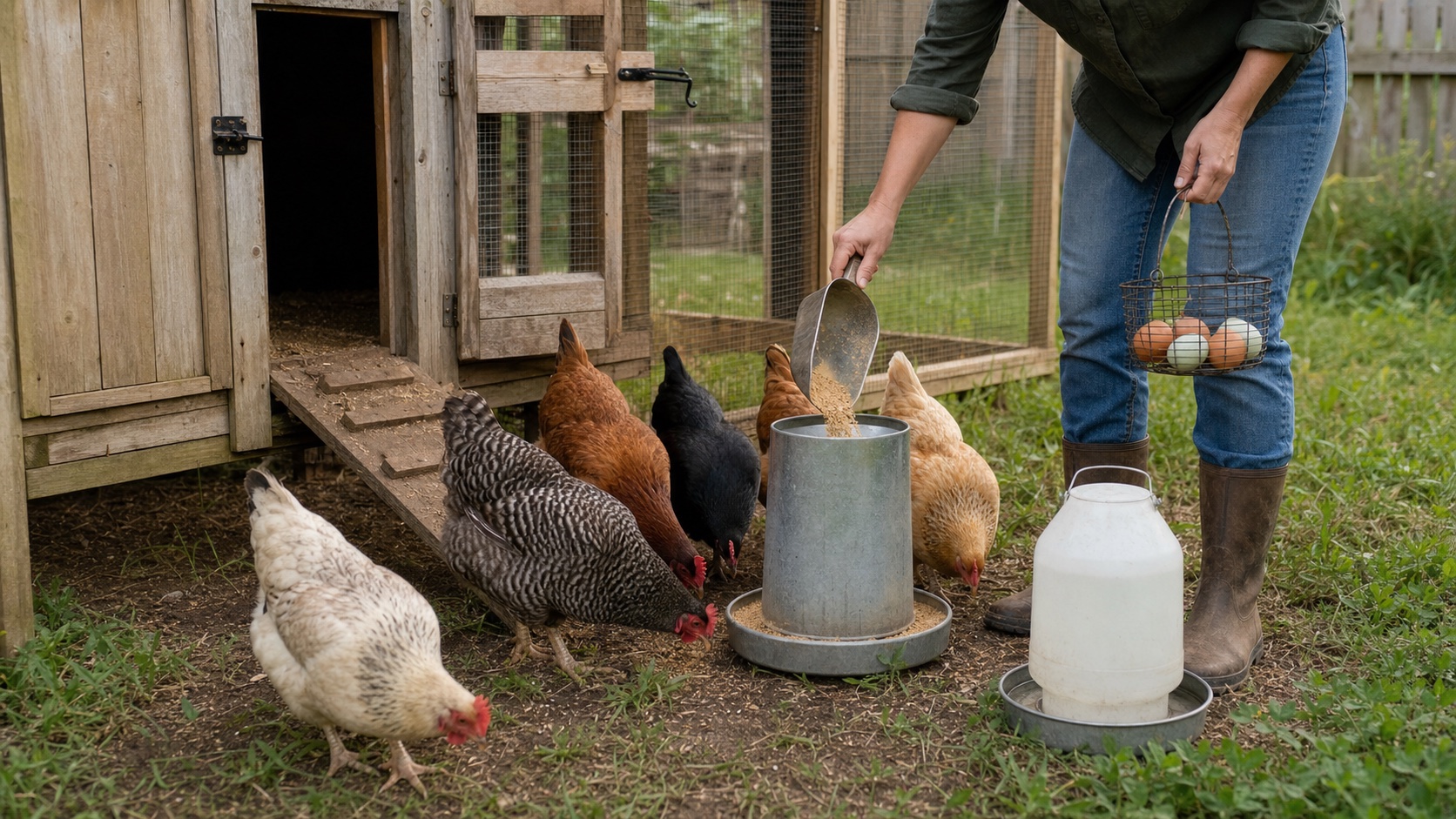
Chickens
Daily Chicken Care Routine for Busy Families
A realistic morning and evening chicken-care routine built around fresh water, feed, eggs, observation, a secure coop, and the few checks busy families should not skip.
Frequently asked questions
What should be in a homestead backup plan?
At minimum, include the people to call, the exact daily care order, animal counts and special needs, water and feed locations, gates and shutoffs, medications or hazards that require qualified handling, what can safely wait, and the conditions that mean the helper should call you, a veterinarian, a utility, or emergency services instead of improvising.
How long should a homestead backup plan be?
The quick-use version should usually fit on one page. Put only the information a helper needs during the first visit on that page, then keep maps, records, veterinary details, insurance information, and full emergency procedures in a clearly labeled binder or secure shared file.
Who should be the backup caretaker?
Choose someone dependable who can reach the property, follow written instructions, communicate clearly, and safely handle the specific chores you expect. A willing neighbor is not automatically qualified for livestock, equipment, medication, electrical work, aggressive animals, or hazardous materials. Match the person to the job and arrange professional help where needed.
How often should you update a homestead backup plan?
Review it when animals, medications, gates, water systems, feed, contacts, access instructions, or household needs change. Also test it at least seasonally and before travel. A current plan that has been walked through once is more useful than a detailed binder no helper has seen.
Is a backup-care sheet the same as a farm emergency action plan?
No. A backup-care sheet helps a trusted person maintain ordinary essential work when the usual caretaker is unavailable. A full emergency action plan may also cover evacuation, fire, severe weather, hazardous materials, emergency access, livestock relocation, insurance, utilities, and coordination with local authorities and professionals. Larger or higher-risk operations need more than this beginner checklist.
Recommendations
Useful tools and resources for this decision
These are included only where they reduce repeated friction, clarify a next step, or help you avoid buying the wrong thing first.
Optional outage tool
Simple refrigerator and freezer appliance thermometers
A basic thermometer in each appliance gives you evidence about food temperature during an outage instead of relying on how cold a package feels.
Best for: Households that store meaningful amounts of refrigerated or frozen food
Skip this purchase if both appliances already have dependable thermometers. A thermometer supports official food-safety guidance; it does not make questionable food safe.
Check current priceFederal preparedness source
Ready.gov household planning resources
Federal planning tools for household communication, alerts, supplies, evacuation, power outages, and local hazards.
Best for: Building the household emergency layer around the homestead care sheet
View resourceLivestock planning source
Penn State Extension livestock emergency planning guide
A practical framework for contacts, animal care, feed and water, facilities, finances, and continuity when a primary livestock caretaker is unavailable.
Best for: Households with livestock or plans more complex than a small backyard routine
View resourceOfficial outage guidance
CDC power-outage safety guidance
Current guidance for food, water, medication, heating, cooling, and generator safety during a power outage.
Best for: Writing the power-loss branch of a household backup plan
View resourceFarm planning source
University of Minnesota Extension farm emergency action plan
Extension guidance for maps, access routes, inventories, contacts, supplies, sheltering, evacuation, and family communication.
Best for: Expanding a one-page care sheet into a property-specific action plan
View resourceRecommended next reads
Read next if it helps the decision
Move into the next guide only if it clarifies the next practical step.
Systems
A Weekly Chore Rhythm for Families Starting Homestead Life
A practical weekly task rhythm for beginners who want household work, animals, meals, and projects to fit real family life.
Systems
How to Build a Beginner Homestead Binder That Actually Gets Used
A practical beginner guide to building a simple homestead binder for chores, garden notes, chicken care, budgets, projects, and weekly decisions without making it complicated.
Chickens
Daily Chicken Care Routine for Busy Families
A realistic morning and evening chicken-care routine built around fresh water, feed, eggs, observation, a secure coop, and the few checks busy families should not skip.
Weekly rhythm support
Get the weekly reset planner that keeps the week from scattering.
A print-friendly weekly planner for resets, anchor tasks, and the few routines that make the house feel steadier.
Best for: Readers who need a calmer household rhythm before they need more projects.
- A weekly anchor planner
- A reset checklist
- A what-to-drop, delay, or delegate review
Low-noise notes on routines, resets, and steadier household systems.
After signup, the download will unlock right here so you can save or print it.
About the author
William Mock
Founder, writer, and beginner homesteader
William writes from the beginner side of rebuilding after a layoff: homestead plans, family systems, budgets, tools, and the decisions that make a home feel less fragile.
Read why this site existsRelated Guides
Keep building context
Systems
A Weekly Chore Rhythm for Families Starting Homestead Life
A practical weekly task rhythm for beginners who want household work, animals, meals, and projects to fit real family life.
Systems
How to Build a Beginner Homestead Binder That Actually Gets Used
A practical beginner guide to building a simple homestead binder for chores, garden notes, chicken care, budgets, projects, and weekly decisions without making it complicated.
Chickens
Daily Chicken Care Routine for Busy Families
A realistic morning and evening chicken-care routine built around fresh water, feed, eggs, observation, a secure coop, and the few checks busy families should not skip.