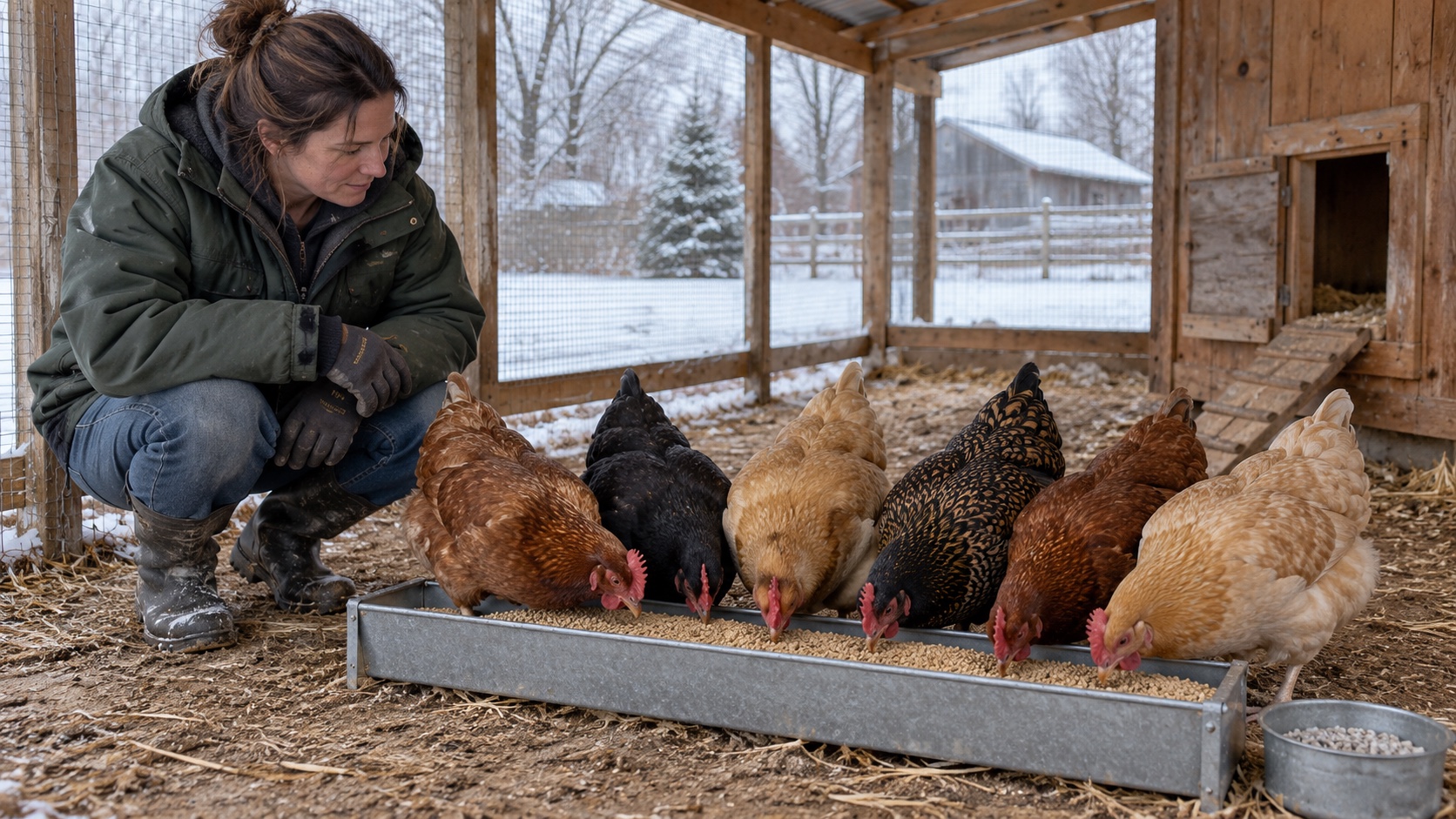
Most chickens should eat the same kind of complete, age-appropriate poultry ration in winter that they need during the rest of the year. Keep it available, expect feed use to rise for some flocks during cold weather, provide clean liquid water, offer suitable grit when birds eat scratch or other coarse foods, and keep treats small. Do not replace balanced feed with corn, kitchen scraps, warm mash, or supplements just because the forecast looks dramatic.
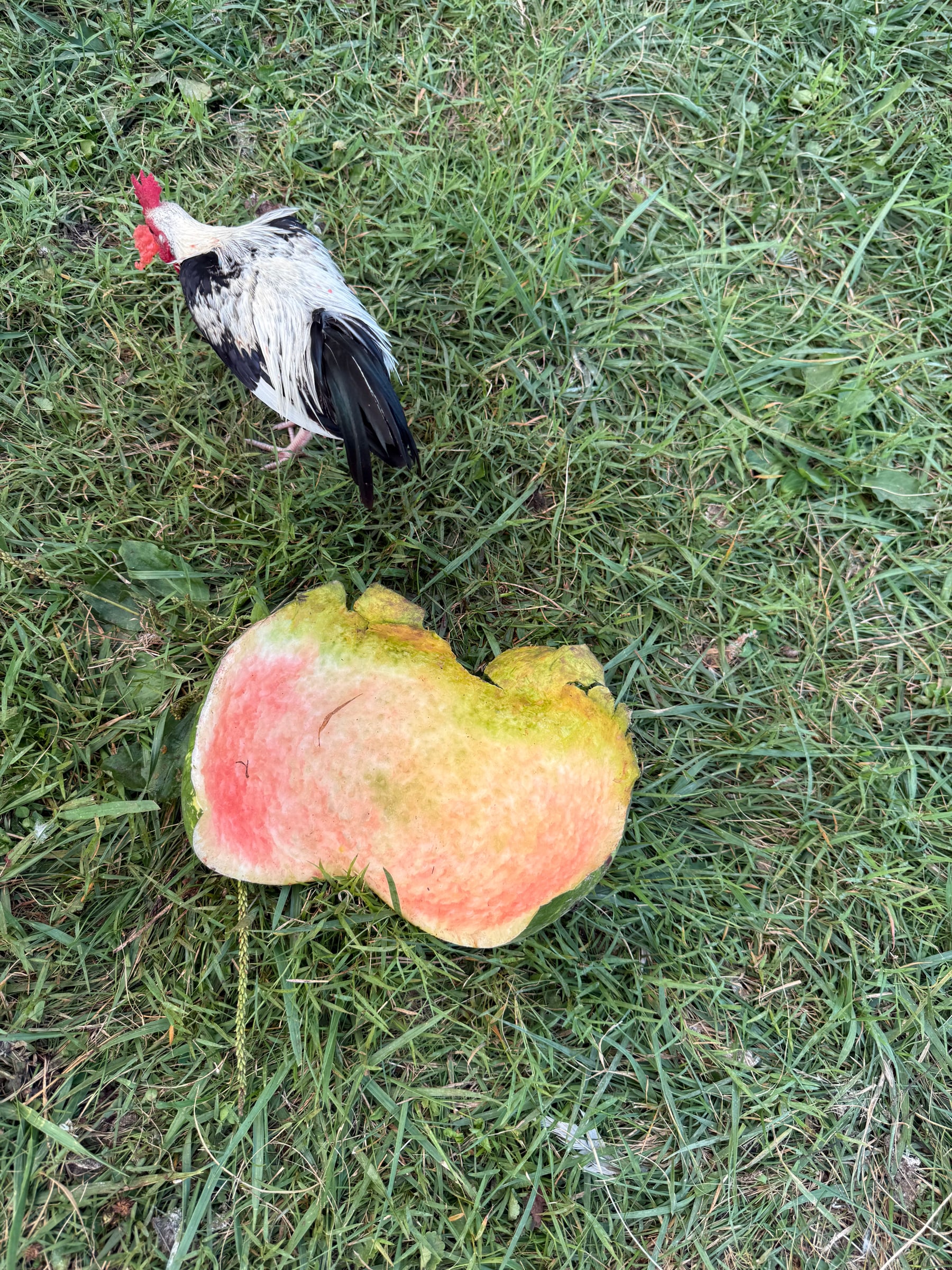
A watermelon rind taught me the winter feeding rule
One of my favorite ordinary chicken scenes is a summer one: our flock gathered around a watermelon rind in the yard. The grass was bright, the rind was clean, and the birds had the focused enthusiasm normally reserved for discovering that a gate might be open. It looked like the perfect picture of turning a family leftover into something useful.
I used that moment in my guide to feeding kitchen scraps to chickens, but the lesson was not that every leftover had found its highest calling. The lesson was restraint. A good treat can still become a bad system when the warm feeling of using it starts outranking the flock's actual nutrition. Chickens do not award bonus points for pantry creativity.
Winter creates the same temptation in a heavier coat. Corn sounds warming. Warm oatmeal sounds caring. Seed blocks look productive. Those extras may have a limited place, but cold weather does not promote them into dinner. I have not run controlled feed trials across breeds and temperatures, and I am not claiming a homemade winter formula. I am carrying one real yard lesson into current Extension guidance: let the complete ration do the nutritional work, then make every extra defend its small place.
Use one winter feeding plan instead of chasing cold-weather fixes
The plan looks almost disappointingly plain. That is useful. Winter already changes daylight, footing, water, shelter use, egg production, and chore timing. Feed should not become another moving part unless a bird, a life stage, or a qualified recommendation gives you a specific reason.
Keep complete feed first, and match it to the bird
A bag labeled poultry feed is not automatically correct for every chicken. Chicks, growing pullets, laying hens, meat birds, and mixed-age flocks can require different formulations. Oregon State University Extension explains that feed programs change with age and production stage. Use the manufacturer's label and current local poultry guidance, and do not give high-calcium layer ration to young birds simply because adult hens share the property.
For an ordinary flock of adult laying hens, a complete layer ration remains the nutritional base through winter. It supplies a designed balance of energy, protein, vitamins, and minerals that a scoop of cracked corn cannot reproduce. Changing to a higher-protein feed, adding fat, mixing a homemade ration, or stacking supplements may be appropriate in a specific case, but those are not automatic winter chores. Ask your local Extension office, feed professional, or poultry-aware veterinarian when molt, weight loss, disease, mixed ages, or production goals complicate the choice.
Stock more feed, but do not force a universal percentage
University of Minnesota Extension says flock feed intake may increase by up to 25 percent during cold weather. That number is useful for inventory planning, not as a command to pour exactly one-quarter more into every feeder. Temperature, wind exposure, body size, feather condition, age, production, activity, housing, and waste all change how quickly a bag disappears.
Keep complete feed available according to the feeding program you use, track when each bag is opened, and compare actual use across ordinary and colder weeks. If the feeder empties faster, first confirm that chickens are eating the feed rather than billing it to wild birds, rodents, dampness, or the hen who treats feeder-scratching as a competitive sport. The separate guide to monthly chicken feed costs includes the bag-price math and a waste margin.
Keep scratch, corn, oatmeal, and treats in the small-print section
Scratch grains can encourage natural scratching and activity, and several Extension sources allow a small evening portion during cold weather. They also agree on the important limit: scratch is not complete feed. Oregon State says scratch can dilute a formulated ration and gives a 10-to-15-percent ceiling; University of Maryland's winter guide says treats and scratch should remain within 10 percent. For a beginner, using the lower 10-percent boundary is simpler and leaves more room for the ration designed to do the real work.
Corn is an ingredient, not a thermostat. Digestion produces heat, but chickens also digest their complete ration. A modest amount of scratch before roosting may fit a healthy adult flock's plan; a feeder full of corn can displace protein, vitamins, and minerals. Warm oatmeal or cooked vegetables may feel generous, but temperature and softness do not make an incomplete food nutritionally complete. Avoid wet food that will freeze, sour, attract pests, or add moisture to the coop, and remove leftovers promptly.
Separate grit, calcium, and water because they do different jobs
Insoluble poultry grit helps the gizzard grind coarse food. Oyster shell is a soluble calcium source commonly offered free-choice to laying hens. One does not replace the other. Birds eating only a prepared complete ration may not need grit to process that ration, but scratch, whole grains, fibrous treats, and reduced ground access change the situation. Minnesota Extension specifically recommends free-choice poultry grit during winter because snow and limited outdoor access can reduce the small stones birds find naturally.
The guide to oyster shell versus grit explains the two stations in detail. Keep both products dry, use a size intended for the birds, and avoid mixing extra calcium indiscriminately into feed for birds that do not need a layer-level calcium intake.
Water is part of the feeding plan, not the chore after it. Oregon State calls clean water essential, and winter guidance consistently emphasizes keeping it liquid. A full feeder beside frozen water is not a working system. Check water according to the actual freeze rate, container, location, flock size, and forecast. If the weak link is equipment, compare manual swaps, a compatible heated base, and a complete heated unit in the winter chicken waterer guide.
Make sure every bird can eat, not just the flock average
A feeder with food in it does not prove that every hen ate. Winter can hold birds inside longer, concentrate traffic, reduce escape space, and expose social pressure that was easier to miss in a larger summer yard. Watch the lower-ranking bird approach the feeder. If she circles, waits, gets pecked away, or eats only after the others leave, add space or a second appropriately placed station rather than assuming the group is covered.
Protect the feed before buying extra bags
Buying ahead can reduce the chance of running out during bad roads or a cold snap, but inventory is not resilience when the bag becomes damp, moldy, stale, contaminated, or available to rodents. Minnesota Extension recommends an animal- and moisture-resistant container. Keep feed in a dry location, rotate oldest stock first, retain the lot information, clean the container between fills, and discard feed that smells wrong, shows mold, has unusual clumping, or has been contaminated.
Use the secure container and building you already have if they work. If an opened bag still sits where moisture and pests are realistic, the Gamma2 Vittles Vault Outback 40-pound container is one researched option. The manufacturer lists food-grade HDPE, a threaded double-gasket lid, and indoor, covered outdoor, or climate-controlled use, with climate control preferred. Capacity varies with feed density. I have not personally tested this container against a determined barn rodent, so I would not call plastic rodent-proof or leave it exposed as the building's only defense.
Skip the purchase if your current metal can or other suitable container stays dry, closes securely, is easy to clean, and fits the bag. The container cannot choose the ration, monitor flock rank, thaw water, or notice a thin hen. It is useful only when storage is the actual weak link. Affiliate purchases may earn Fresh Start Homestead a commission at no added cost to you.
Recommendations
Winter feed resources and one optional storage tool
Read the Minnesota guide
University of Minnesota Extension cold-weather chicken guide
Current guidance on balanced ration, increased cold-weather intake, storage, grit, scratch, water, and cold-stress observation.
Best for: Checking the whole winter system before changing feed
View resourceRead the OSU guide
Oregon State University Extension laying-hen feed guide
A practical reference for complete feed, scratch limits, treats, grit, oyster shell, and clean water.
Best for: Understanding why the complete ration stays first
View resourceSee the feed container
Gamma2 Vittles Vault Outback stackable container, 40 lb
A sealed food-grade HDPE container for an opened dry-feed bag in a protected storage location.
Best for: Small flocks that lack clean, dry, sealed feed storage
Check current priceUse this seven-step feeding check before a cold snap
A realistic winter feeding day for six hens
Picture six adult laying hens before a two-day cold snap. Their normal complete layer ration is correct, the bag is dry, and the feeder is protected. You note that recent cold weeks emptied the bag faster, so you buy the next bag before the roads turn bad. You do not switch feeds or pour corn over the feeder. You refill the complete ration, put insoluble grit in its separate station, confirm oyster shell is available for the layers, and test the backup water bowl.
At the morning check, five hens crowd the feeder while the smallest waits behind them. That is the useful discovery. You add a second protected feeding point far enough away that one dominant bird cannot control both. Later, a small scratch portion gives the flock something to work through, and leftovers are removed. The successful winter adjustment was not a secret ingredient. It was noticing the hen who had been edited out of the flock average.
What matters first and what can wait
Keep the winter menu boring enough to observe
A useful winter feed plan is easy to describe to another person: this is the correct complete feed, this is where it stays dry, this is how every bird reaches it, this is the water backup, and this is when we check again. Grit, calcium, and treats have defined places. Nobody has to interpret a shelf of powders while wearing gloves.
Start with the ration already doing its job. Stock enough to cover ordinary bad weather. Watch the bird at the edge of the feeder. Then change only what the flock, the label, and qualified guidance show needs changing. That is less exciting than inventing a winter recipe, but it is a much better way to keep six chickens from becoming six separate nutrition experiments.
Best Next Step
Build the rest of the winter flock plan.
Use the first-freeze guide to check water, ventilation, bedding, shelter, feed storage, vulnerable birds, and the family backup routine before the next cold snap.
Read the winter chicken checklistRecommended next reads
Continue your winter chicken plan
These guides cover the next decisions without repeating the ration question.
Chickens
Winter Chicken Care for Beginners: Prepare Before the First Freeze
A practical first-winter checklist for unfrozen water, dry bedding, useful ventilation, safe power, flock checks, feed, frostbite risk, and cold-weather routines.
Chickens
Chicken Feed Costs for Beginners: Monthly Numbers That Actually Matter
A practical guide to monthly chicken feed costs for beginners, including feed math, flock size, waste, storage, and the recurring costs that make egg math more honest.
Chickens
Heated Chicken Waterer vs. Heated Base: What Beginners Need for Winter
Compare a heated chicken waterer, a heated base, and manual bowl swaps so you can keep winter water available without buying the wrong setup.
Frequently asked questions
What is the best feed for chickens in winter?
For most backyard flocks, the winter foundation is the same complete, age-appropriate poultry ration used during the rest of the year. Laying hens need a complete layer ration; chicks, pullets, meat birds, and mixed-age flocks have different nutritional needs. Keep the correct feed available, provide clean liquid water, and ask your local Extension office or poultry veterinarian before changing protein, calories, or supplements for a health concern.
Do chickens need more feed in winter?
They may eat more as cold conditions increase energy demand. University of Minnesota Extension says flock feed intake may increase by as much as 25 percent during cold weather, but that is a planning ceiling rather than an instruction to add exactly 25 percent for every flock. Keep complete feed available, track how quickly it disappears, reduce waste, and watch body condition and individual access.
Should chickens eat corn or scratch before bed in winter?
Scratch grain can be offered as a small treat and activity, but it is not a complete ration and should not replace balanced feed. Current Extension guidance commonly limits treats and scratch to about 10 percent of intake, while some sources allow up to 10 to 15 percent. A conservative beginner plan is to keep all extras small, offer them only after birds have eaten their complete feed, and provide insoluble grit when whole grains or scratch are used.
Do chickens need grit in winter?
Chickens eating only a prepared complete ration may not need extra grit to process that feed, but birds receiving scratch, whole grains, forage, or fibrous treats need suitable insoluble poultry grit. Snow cover and limited ground access can remove the small stones birds might otherwise find, so University Extension guidance recommends offering poultry grit free-choice in winter. Oyster shell is a calcium source for laying hens, not a substitute for grit.
What should I do if one chicken is losing weight in winter?
Do not assume that more corn will solve unexplained weight loss. Watch whether the bird can reach feed and water, separate her for an individual check when appropriate, review age, molt, flock rank, parasites, illness, injury, and feed suitability, and contact a poultry-aware veterinarian. A bird that is weak, isolated, not eating, struggling to breathe, or behaving abnormally needs individual attention rather than a flock-wide menu change.
Recommendations
Useful tools and resources for this decision
These are included only where they reduce repeated friction, clarify a next step, or help you avoid buying the wrong thing first.
Read the Minnesota guide
University of Minnesota Extension cold-weather chicken guide
Current winter guidance covering balanced ration, increased cold-weather intake, feed storage, grit, scratch, water, housing, and individual cold stress.
Best for: Reviewing the full winter feeding and housing system
View resourceRead the OSU feed guide
Oregon State University Extension laying-hen feed guide
A detailed guide to complete rations, life-stage feeds, water, scratch grain, treats, grit, oyster shell, and winter pasture limits.
Best for: Understanding what complete feed does and why extras stay limited
View resourceRead the Maryland guide
University of Maryland Extension winter flock guide
Cold-weather small-flock guidance on feed availability, limiting energy-dense treats and scratch, water, bedding, ventilation, and frostbite risk.
Best for: Checking a simple cold-weather feeding routine
View resourceRead the Delaware guide
University of Delaware Extension chicken food and water guide
Beginner-friendly guidance on balanced layer feed, limited treats, grit, clean water, feeder access, and daily observation.
Best for: Reviewing feeding basics with a family or first-time keeper
View resourceSee the feed container
Gamma2 Vittles Vault Outback stackable container, 40 lb
A sealed food-grade HDPE container with a threaded double-gasket lid for dry feed storage in an indoor, covered, or climate-controlled location.
Best for: A small flock whose opened feed bag lacks dependable dry, sealed storage
Check current priceRecommended next reads
Read next if it helps the decision
Move into the next guide only if it clarifies the next practical step.
Chickens
Winter Chicken Care for Beginners: Prepare Before the First Freeze
A practical first-winter checklist for unfrozen water, dry bedding, useful ventilation, safe power, flock checks, feed, frostbite risk, and cold-weather routines.
Chickens
Chicken Feed Costs for Beginners: Monthly Numbers That Actually Matter
A practical guide to monthly chicken feed costs for beginners, including feed math, flock size, waste, storage, and the recurring costs that make egg math more honest.
Chickens
Heated Chicken Waterer vs. Heated Base: What Beginners Need for Winter
Compare a heated chicken waterer, a heated base, and manual bowl swaps so you can keep winter water available without buying the wrong setup.
Chicken setup support
Get the chicken setup checklist before you buy more flock gear.
Use the first-year checklist to price the flock honestly, cover the starter essentials, and delay the upgrades that can wait.
Best for: Readers trying to price a first flock honestly and avoid a scattered chicken setup.
- A pre-chick setup checklist
- A recurring-cost planning section
- A simple weekly flock-care rhythm
Chicken setup notes, beginner flock lessons, and the checklist first.
After signup, the download will unlock right here so you can save or print it.
About the author
William Mock
Founder, writer, and beginner homesteader
William writes from the beginner side of rebuilding after a layoff: homestead plans, family systems, budgets, tools, and the decisions that make a home feel less fragile.
Read why this site existsRelated Guides
Keep building context
Chickens
Winter Chicken Care for Beginners: Prepare Before the First Freeze
A practical first-winter checklist for unfrozen water, dry bedding, useful ventilation, safe power, flock checks, feed, frostbite risk, and cold-weather routines.
Chickens
Chicken Feed Costs for Beginners: Monthly Numbers That Actually Matter
A practical guide to monthly chicken feed costs for beginners, including feed math, flock size, waste, storage, and the recurring costs that make egg math more honest.
Chickens
Can Chickens Eat Kitchen Scraps? Beginner Rules Before You Toss Food in the Run
A practical beginner guide to feeding kitchen scraps to chickens without replacing balanced feed, creating pests, or turning every leftover into a flock experiment.